
Canada Cannot Diversify by Half Measures
The Number Canada Should Chase


Two days ago, Concis Canada announced that we will be tracking consolidated port traffic data. That matters. It gives us a cleaner way to read the impact of Canada’s trade reorganization than GDP or inflation, both of which absorb too much U.S. noise.
But even that has limits.
Port traffic is still a post-event signal. It tells us what has already happened. It helps us stay aware. It does not tell us, early enough, where the country is actually heading.
So if the goal is to see whether Canada is positioning itself to win, we need to look beyond post-event indicators and focus on the forward-looking signals that matter most. And those signals sit in a few core areas. If Canada keeps pushing in them, it will not only strengthen its own national security. It will also reinforce the democratic alliance, weaken the autocrats, narrow the operating space of American oligarchs, and improve the Canadian economy over the long run.
What is there not to like?
The list is not long.
LNG production.
Crude oil exports to non-U.S. markets.
Nuclear and renewable energy.
That is the industrial front.
On the alliance front, Carney appears to be following a variable-geometry model: building multiple alliances at once, each with its own structure, depth, and purpose. That approach makes sense. All of those links matter. But one connection stands above the rest. If done properly, it could put the democratic world on a very different path.
That connection is Canada and Australia.
The Carney government should remove the mobility barriers that still exist between the two countries. On the workforce front, there should be as little friction as possible. Make it easy to work in Canada and Australia. Easy enough that, over time, people begin to forget they are operating across two separate countries. Labour mobility matters that much. Yes, Canada is also thinking in larger CANZUK terms. Fine. But if that broader structure takes years to build, that is no reason to make the Canada-Australia track wait.
Treat it differently. Give it priority. Make it special. And then, one day, make it so normal that it no longer feels special at all. That is entirely doable. They should get moving.
Circling back to the industrial track, we have some good news on the LNG front and also one extremely clear bad signal. Let us get the bad one out of our way first.
The disruption to global liquefied natural gas supplies caused by the Iran war makes it more likely that a second stage of Canada’s massive LNG Canada facility will be built, the CEO of Canadian pipeline company TC Energy predicted in Houston on Monday.
Wait, what?
It is exactly that thinking, that creates graphs like the following:
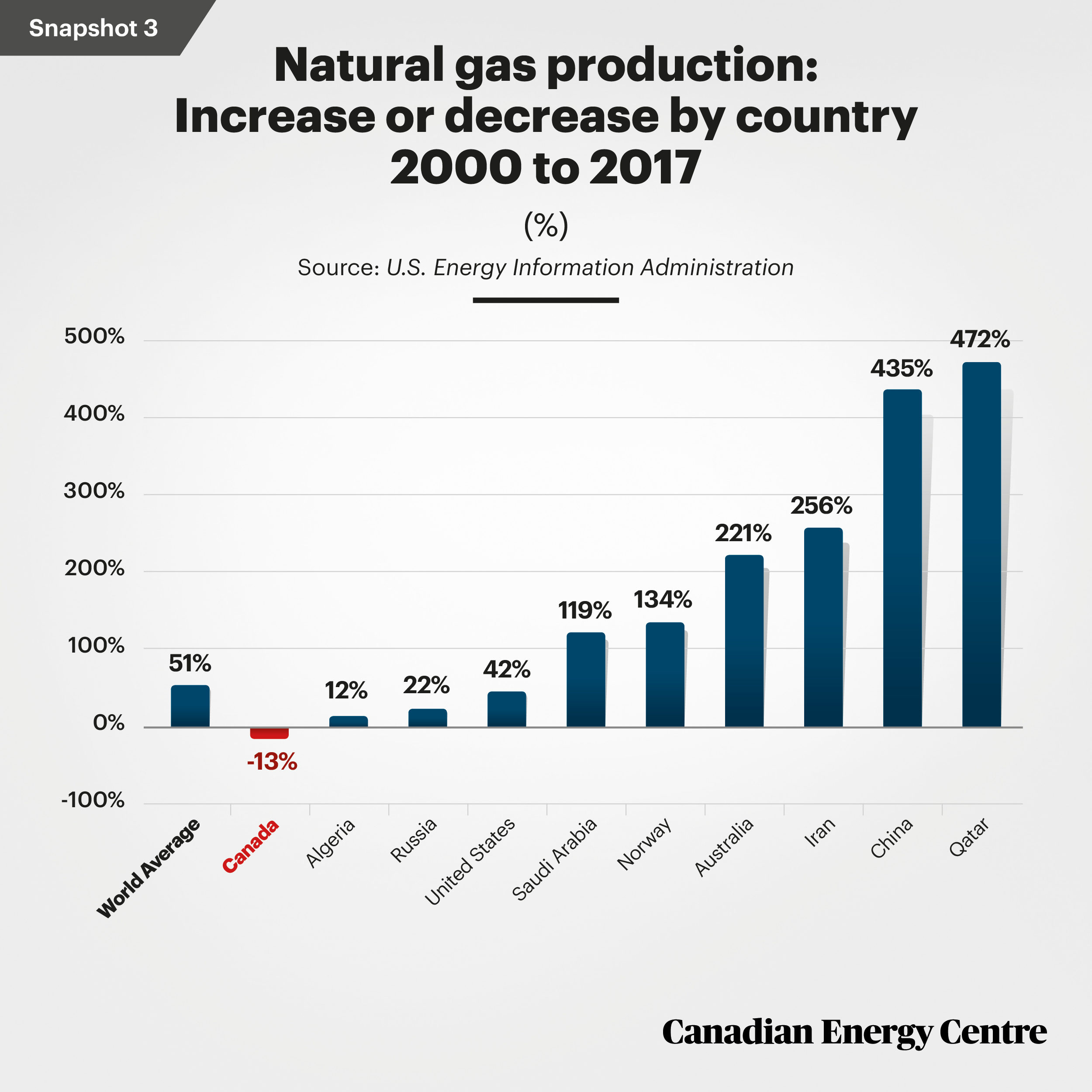
and this:
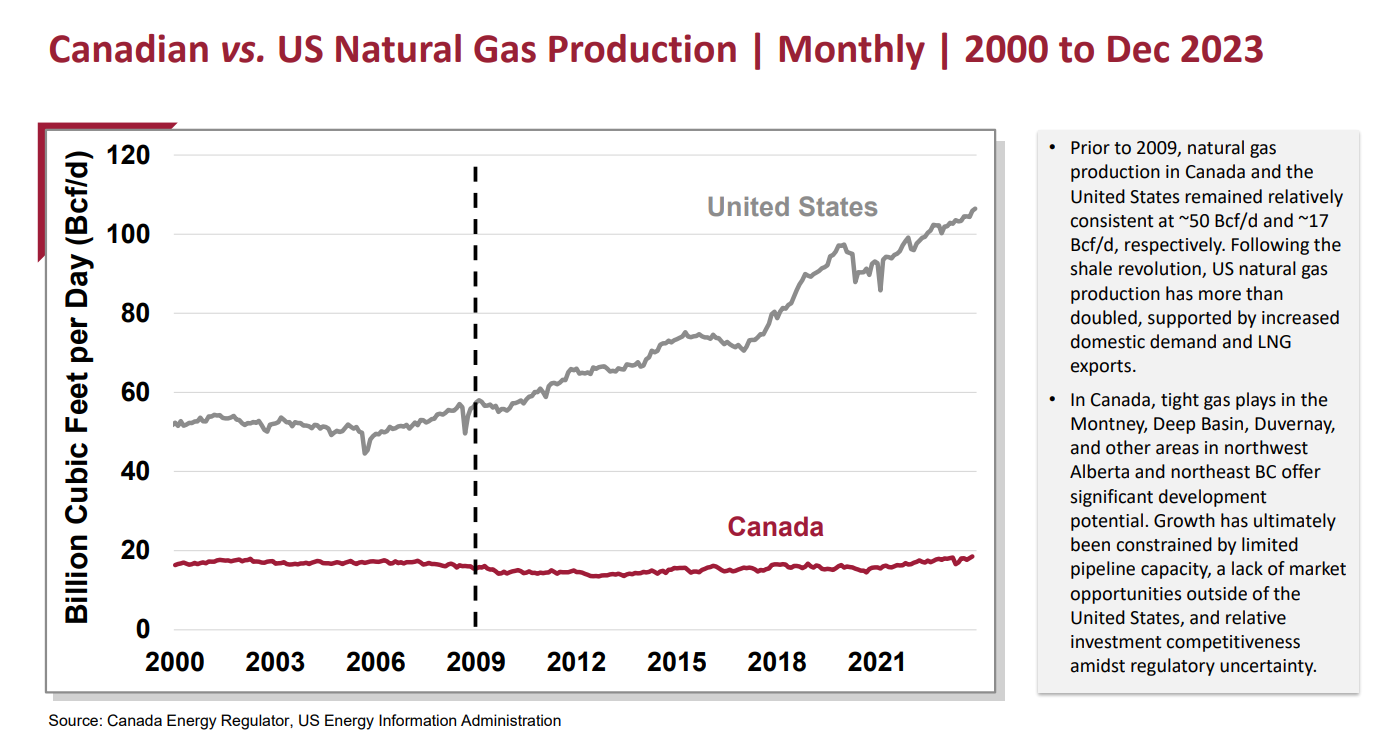
Global natural gas consumption is not going to surge over the next decade. At best, it stays flat. At worst, it declines modestly. So why are the United States, the Gulf states, and China still ramping up production?
Because this is not just about meeting demand. It is about controlling the market.
A real struggle is underway between today’s autocrats, and men who want to become autocrats, to tighten their grip over the global energy system. That includes oil. That includes gas. And increasingly, it includes the strategic use of supply, disruption, and dependency as instruments of power.
This is the newer model. Exploit the democratic world’s dependence on commodities, then turn that dependence into leverage.
The Trump administration reportedly offered a billion dollars to a French energy company to steer it toward fossil fuels over renewables. Trump himself said publicly that he wants to take Iran’s oil.
Oil was also what pulled him toward Venezuela. He is not simply looking at Middle East instability and concluding that the world needs more oil and gas. He is helping manufacture crisis inside a system of dependence he wants to exploit.
And yet, even within all of that, there is still a market. There is still demand. So why do Canadian industry leaders behave as though that market is meant for someone else to capture?
There is no reason for that.
Compete.
Now, the good news:
Coastal GasLink (built and still partly owned by TC Energy) got the commercial contracts for an expansion to supply LNG Canada Phase 2.
LNG Canada liquefies Canadian natural gas for export to Asian markets. Its initial target is 14 million tonnes of LNG per year from Kitimat, British Columbia, which works out to roughly 1.84 Bcf/d of natural gas.
By comparison, Canada’s natural gas exports to the United States averaged about 8.8 Bcf/d in 2024.
That comparison matters because it shows the scale of the gap. LNG Canada Phase 1 is not small, but it is still only a fraction of Canada’s pipeline gas exports to the U.S. If Ottawa is serious about diversification, it cannot think in marginal terms.
Canada should not stop until LNG export capacity reaches 9 Bcf/d.
That is the number to chase. Not the situation in the Middle East, not the noise of the day, and not any other distraction. The objective is straightforward: build enough export capacity so Canada is no longer structurally trapped inside a single external market.
Your support for Concis Canada is critical in moments like this. It allows us to dig deeper, investigate harder, and keep Canadians informed about the decisions shaping their future. It will help us reach more people across the country and show the world the role Canada plays within the democratic alliance.
Great insights as always, Shankar. I believe what you're seeing is the legacy of our former PM, who dithered and treated traditional energy sources as evil, though sometimes a necessary evil. Other than taking on the completion of the pipeline to the West Coast, his policies seemed to be inspired by the factions that think we can flip and switch and go electric. It also focused on the micro (oil = bad) vs. the macro (oil replacing coal in overseas power generation = overall net CO2 reduction). When Germany came to Ottawa to ask us to ship them LNG, Trudeau told them, "Sorry, no." So they reactivated several mothballed coal-fired power plants, while we lost billions in revenue that would have helped reduce net CO2 production. And while we were curtailing our traditional energy production, countries like China were building hundreds of coal-fired generating stations. Who is the biggest recipient of oil from our West Coast pipeline today? As you stated, all of the projects we're undertaking and considering take time. Unfortunately, that limits our ability to be opportunistic today. That's costing us hundreds of billions in opportunity cost. Trump has provided us with such a great opportunity...funny how that works!
I would personally love greater ties with Australia, but, forgive my ignorance, while you have explained the WHAT, I'm not sure I follow the WHY... Why would a deeper Canada-Australia connection matter that much to the democratic world? Combined population is about 69 million, only slightly more than the UK itself and barely 20% of the US population. It would obviously make a difference for those of us living in either country, but not quite seeing how it affects, say, Japan, S Korea, Denmark, etc.?