
Canada Cannot Rent the Future
The World Is Building Compute. Canada Cannot Stand Outside.

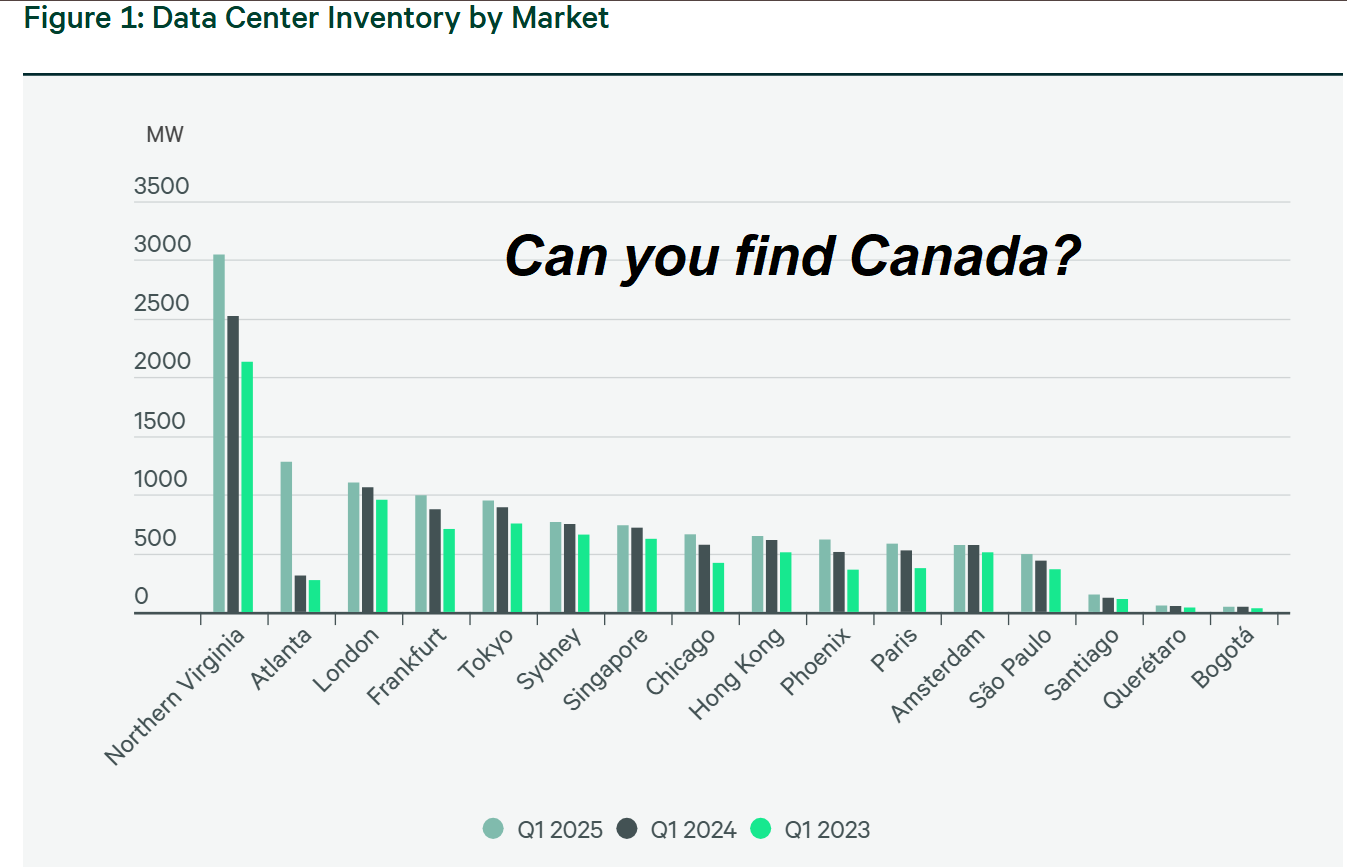
Hong Kong, yes. We can take that hit. But Santiago, Chile? Querétaro, Mexico? Bogotá, Colombia?
Where in the world is Canada?
That is the uncomfortable part of the global data-centre map. Canada does have data centres. It has real capacity. It has facilities across Toronto, Montréal, Vancouver, Calgary, Alberta, and a wider layer of smaller enterprise and edge sites.
But no Canadian metro is large enough yet to break into that global top-market chart.
That is the problem. The chart is not ranking countries. It is ranking concentrated data-centre markets. That is why Northern Virginia appears. London appears. Frankfurt appears. Tokyo appears. Singapore appears. And, yes, Querétaro, Bogotá, and Santiago appear.
Canada does not.
Not because Canada lacks the ingredients. That would be easier to explain. Canada has almost everything the next compute economy needs: hydro, cold climate, land, political stability, AI talent, proximity to the United States, and a serious base of research capacity. The problem is worse than scarcity.
It is under-conversion.
Canada has the advantages, but it has not yet converted them into a single globally visible mega-market. Mexico, Chile, and Colombia got onto that map because their national data-centre demand is concentrated in one dominant metro. Canada is richer, colder, more stable, better powered, and better positioned for the AI era.
But its capacity is distributed. And underbuilt.
That is the gap.
If Canada wants to show up on maps like this, the answer is not another layer of small enterprise data centres scattered politely across the country. It needs large AI-focused compute clusters tied directly to power, national strategy, industrial policy, and sovereign capacity.
That is why Prime Minister Mark Carney’s recent announcement matters.
Ottawa and TELUS are now moving toward a three-site AI “factory” cluster in British Columbia. The plan includes an expansion of TELUS’s existing Kamloops data centre, plus two Vancouver facilities, including a proposed 400,000-square-foot site at 150 West Georgia near BC Place.
TELUS says the cluster could generate about $9 billion in economic activity. Other reporting says it could eventually scale to more than 60,000 GPUs and 150 MW of capacity by 2032.
This is not a “build first, regulate later” model.
This is a “build now, so you do not cry later” model.
But why build megacentres? Why is everyone building big instead of spreading the load across smaller distributed sites?
