
Canada Found the Eastern Flank. Now Fund It.
C$21 Million Is Not a Strategy

I can’t believe I am doing this.
I am writing a story before the thing has even fully developed. That is usually not how I prefer to work. But Concis Canada is not built to do exactly what The Concis does.
The Concis was built for precision, judgment, and accountability, especially on Ukraine. Move slow. Read the battlefield. Read the politics. Make the recommendation. Push where the system needs to be pushed.
Concis Canada has a different role.
This desk has to become a place where recommendations are made first in the people’s court. We make the case in public. You read it. You push back. You add context. Then we take that public argument and feed it back into the system.
The reverse also has to happen. When the government acts, we read what it has done, test it in public, express our view, keep the debate inside the people’s court, and then carry that feedback back toward the administration.
Yes, that means we are collapsing the old structure. The old model of journalism is done. It has been bought, softened, gamed, and turned into a rage machine. Insinuation. Outrage. Eyeballs. Lies dressed up as analysis. Everyone performs. Everyone reacts. Everyone pretends the noise is the work.
That is not where Concis Canada will sit. That is not how I am going to build the Canadian desk. We are going to make the case in public first, and then make the public part of the case.
Canada’s foreign minister, Anita Anand, is headed to the Baltics and then to Sweden. Latvia. Estonia. Sweden.
In Estonia, she is joining the Canada-Baltics “3+1” meeting with Estonia, Latvia, and Lithuania. The agenda will obviously include plenty: Ukraine, NATO, the eastern flank, economic resilience, critical supply chains, and whatever else diplomats can safely put into communiqués.
The format itself is not new. Canada and the Baltic foreign ministers started this 3+1 channel on October 16, 2020.
So I went looking. What has it achieved in the last four or five years?
Because life in the Baltics today is not what it was in October 2020. Russia’s war against Ukraine has changed the entire map. The Baltics and Poland are next in line if Putin finds a way to stay inside the war long enough to regenerate pressure against NATO’s eastern flank.
So naturally, I expected to find something.
A defense instrument. A trade corridor. A technology partnership. An investment pool. Something that showed Canada and the Baltics had used the format to deepen the relationship in a serious way.
Instead, I found photographs. A few statements. A few meetings. A few polite diplomatic moments. And then the numbers.
Canadian direct investment in Estonia stood at C$12 million in 2024. Lithuania: C$6 million. Latvia: C$3 million. That is C$21 million across three front-line Baltic democracies with a combined GDP of roughly US$172 billion.
I guess that tells the story we do not want to hear. The 3+1 format appears to have helped Canada show diplomatic support for the Baltics. That is not nothing. But it is not enough. These three countries sit at the front of the eastern flank. They are not random partners. They are strategic terrain.
We sincerely hope Anita Anand changes this.
There are plenty of places for Canada to work.
Estonia’s tech sector alone is worth roughly €1.7 billion and represents about 7.6% of its GDP. Canada needs to expand its AI and compute footprint. Estonia has cyber depth, digital-state infrastructure, and a security-technology culture that fits exactly where the democratic alliance is headed.
So why not start there?
We are not sure how the Carney administration plans to use the sovereign wealth fund. What we do know is that it is meant for nation-building. So let’s ask the obvious question.
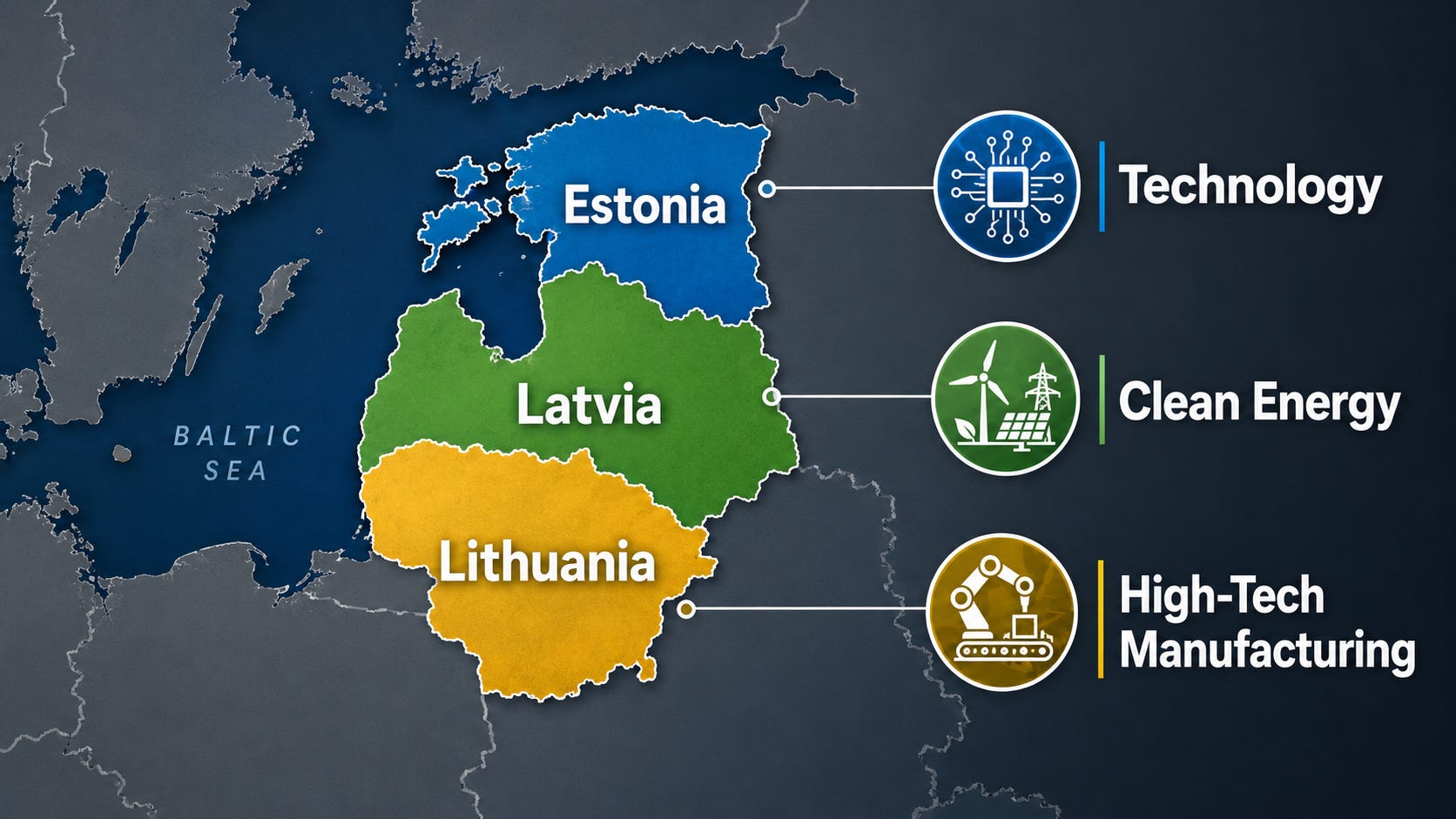
Would a targeted investment to deepen Canada’s technology relationship with Estonia, clean-energy cooperation with Latvia, and high-tech manufacturing ties with Lithuania qualify as nation-building?
A C$50 million Baltic investment package that improves two-way trade, plugs Canada into three front-line democracies, and gives Canadian firms access to growth sectors sounds like nation-building to me.
Maybe that is not traditionally the foreign minister’s job. But aren’t we way past working in silos?
Give us something to work on, Minister. We have had a lot of photographs.
Tiny is okay. Tiny can grow. But it has to be built to give way to growth.
When it comes to Canada’s trade dependence on the United States, every million rerouted or expanded into another part of the world counts. Percentage by percentage. Relationship by relationship. Corridor by corridor.
And it does look like Canada has a fat little percentage sitting in the Baltics, waiting to be tapped.
So tap it.
Your support for Concis Canada is critical in moments like this. It allows us to dig deeper, investigate harder, and keep Canadians informed about the decisions shaping their future.
It will help us reach more people across the country and show the world the role Canada plays within the democratic alliance.
I can absolutely recommend the tech industry in Estonia. I’ve been watching them for years. Canada would benefit from partnership and investment for certain.
Almost by definition, mutual and voluntary investment and trade amoung friendly nations is nation building. This is what the post-war world order was all about. The ideas behind that order were promoted among others by the economist J.M. Keynes, and seconded by the U.S. in their own trade laws that generalized the "most favored nation" principle. Canada must now, simply but resolutely, carry that torch from the faltering hands of our southern neighbor.