
Canada is moving from “friendly Atlantic partner” to semi-integrated European strategic actor.
Not EU member. Not candidate state. Not legally inside the bloc.

When Mark Carney stood in Yerevan, Armenia, at the meeting of the European Political Community, he said something that landed harder than a normal summit line.
“We don’t think that we’re destined to submit to a more transactional, insular and brutal world, and gatherings such as these point to a better way forward,” he said.
On paper, he was speaking at a European gathering. In the room, he was addressing European leaders. In the headline cycle, the quote naturally became a Europe story.
But Carney did something larger there. Whether he meant to do it or not, he collapsed the distance between Europe and Canada. He took a sentence that could have been read as a narrow European message and turned it into a democratic alliance frame.
And he is not going to complain about what happened next. He is more likely to smile when he sees headlines like this.
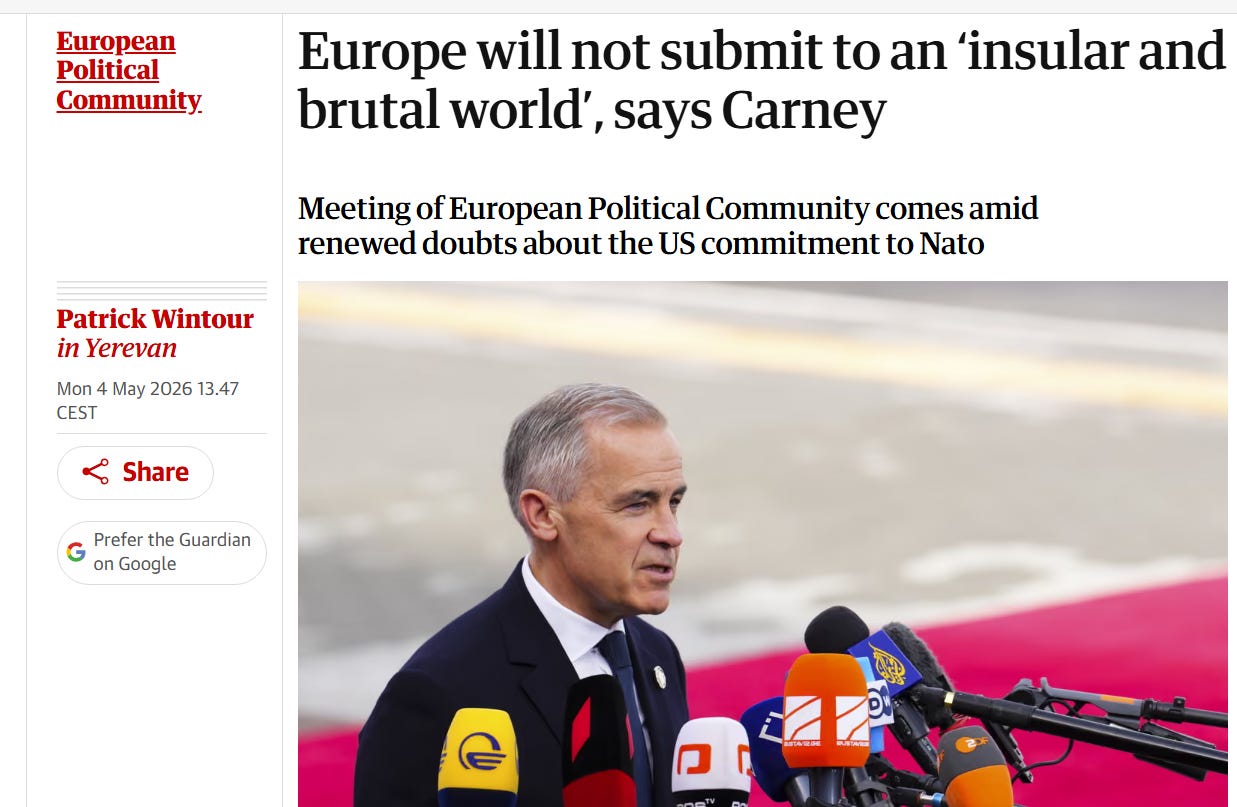
The Guardian thought Carney was talking about Europe.
I think he was talking about Europe, Canada, and anyone prepared to join the democratic alliance now being built. That is the real move here. He pulled Canada into Europe’s political-security sentence without asking anyone for permission first.
That is how you change the map. Today Bloomberg said that Canada is starting to act like EU’s 28th state. May be. Why not? If Canada is brutally selfish, that is exactly what it will do. If Canada is equally magnanimous, that is what it will do, because it helps preserve the democratic world that is increasingly eyed as markets to be plundered by a gang of autocrats and their oligarchs.
The economic incentive for Canada is not small. The EU is Canada’s second-largest trading partner for goods and services, with Canada-EU trade reaching $178.6 billion in 2025. The EU is also Canada’s second-largest source of foreign direct investment after the U.S.; the Canadian government says EU FDI stock in Canada was estimated at $218.8 billion in 2025, while Canadian direct investment in the EU totaled $297 billion. There is plenty to top up here.
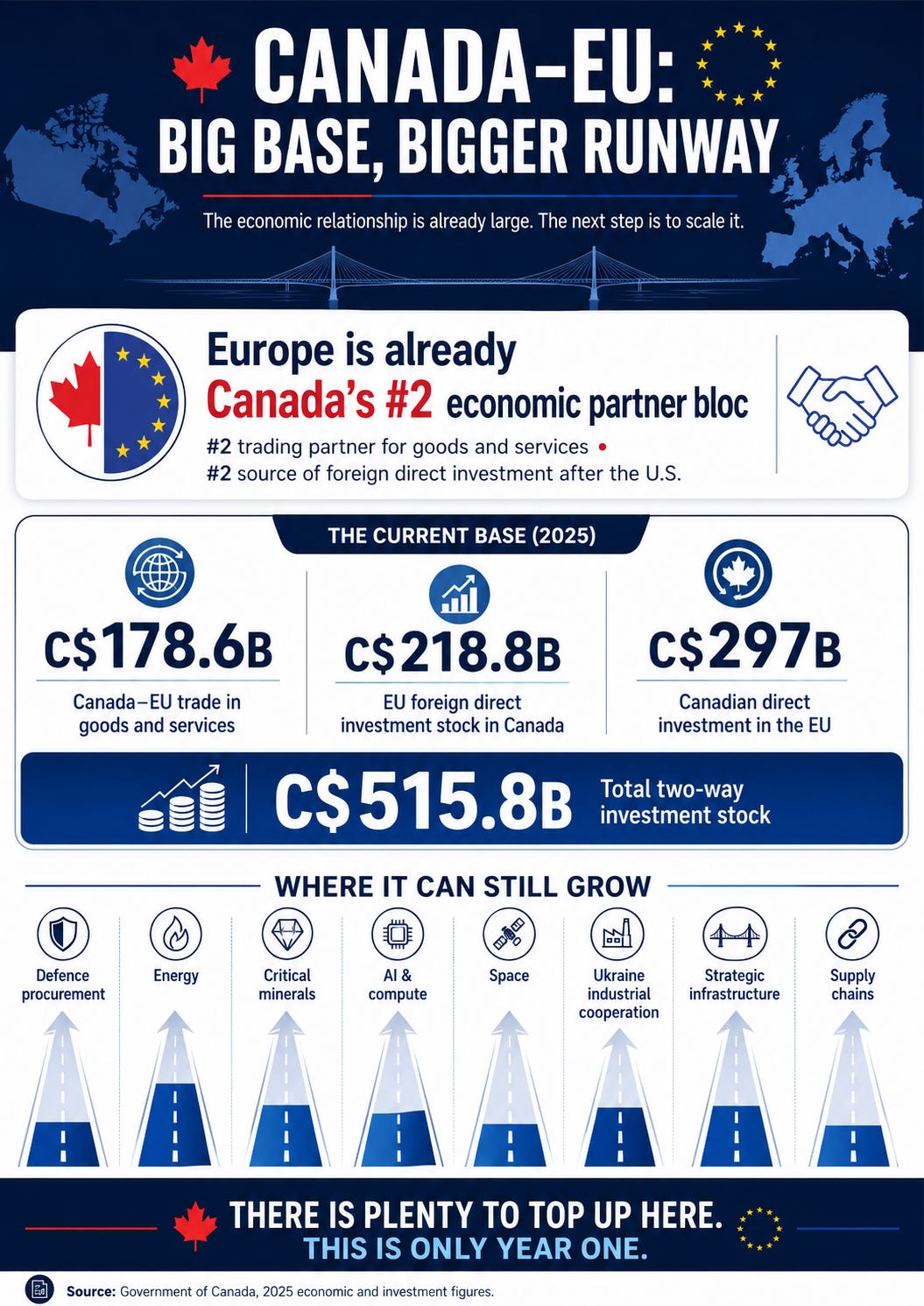
Canada is now entering the European system through defence procurement, political summits, strategic partnerships, energy, critical minerals, AI, space, Ukraine policy, and institutional representation in Brussels.
Foreign Minister Anita Anand reinforced that point in Brussels this week. She told Euronews that Canada’s EU relationship is not just a reaction to Trump. It is a long-term middle-power strategy built around shared values, territorial integrity, sovereignty, multilateral trade, defence, security, agriculture, AI, and economic interests.
Then she added the line that caught my attention. Canada, she said, has signed more than 20 security, defence, and economic agreements around the world over the last year and is “just getting started.”
I liked that line because it is true.
Canada is nowhere near where it should be with the EU on trade, defence, energy, critical minerals, space, AI, and industrial strategy. This is not the end of the move. This is year one. That is all there is to it.
One bureaucratic move gives me real confidence that Ottawa will keep pressing in this direction. Canada has created dedicated institutional machinery for the EU file.
On October 1, 2025, Carney appointed John Hannaford as his Personal Representative to the European Union, with a mandate to accelerate work on trade, economic security, climate competitiveness, and defence collaboration.
That is a serious signal. You do not appoint a personal representative to Brussels unless the file has become structurally important.
And Hannaford is already active. He met Helen McEntee, Ireland’s Minister of State for Foreign Affairs and Trade, in Brussels yesterday. Carney is also set to visit Dublin in June.
So this is not a ceremonial envoy sitting quietly on the edge of the system. Hannaford is in Brussels right now, doing the institutional stitching that turns speeches into structure.
But no, Bloomberg.
Canada is not acting like the EU’s 28th member state.
It is acting like a country that naturally gravitates toward a group whose values, interests, and strategic future increasingly overlap with its own.
Your support for Concis Canada is critical in moments like this. It allows us to dig deeper, investigate harder, and keep Canadians informed about the decisions shaping their future. It will help us reach more people across the country and show the world the role Canada plays within the democratic alliance.
No matter what happens next I firmly believe that with Carney at the lead, Canada is going to be OK. Maybtake a few years to see the fruit but the trees are being planted, the fields sowed…🇨🇦🇨🇦🇨🇦
Canada is finding her own way of dealing with the new world we are facing. A seemingly small appointment of one person, might have an outsize effect. Good.