
Canada’s 6.7% Panic Is Missing the Point
The Trendline Nobody Wants to See

One number. That’s all it takes for the right to slip into holier-than-thou mode.
Yes, Canada’s unemployment rate ticked up to 6.7%. The Labour Force Survey shows that “in February, the number of people working full-time declined by 108,000 (-0.6%), offsetting growth recorded over the previous two months.”
What’s missing from the outrage cycle is memory. Recent gains passed without applause. No victory laps. No sudden discovery of economic competence. But one reversal, and the verdict arrives fully formed.
It is also worth keeping the number in proportion. Canada’s unemployment rate is not drifting in some isolated failure zone. It is still moving within the same band as the developed world.
In January 2026, unemployment across the European Union stood at 5.9%, with the euro area at 6.1%—both holding near record lows.
That doesn’t mean the signal should be ignored. The employment curve has been soft for a while, and the direction is unlikely to improve quickly. Canada is being pulled through two simultaneous pressures: a geopolitical shock radiating out of Iran, and a structural reorganization of trade as the United States, under a MAGA-aligned policy framework, continues to apply sustained economic pressure.
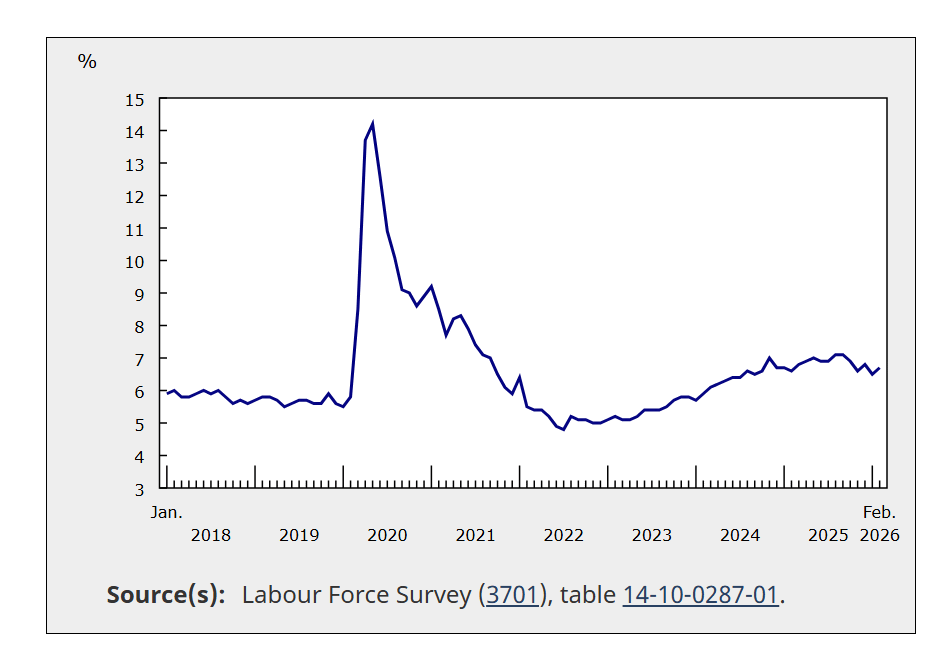
What actually makes this graph look uncomfortable is not the level. It’s the direction.
Since July 2022, the line has been edging higher. Not sharply. Not dramatically. But consistently enough that the trendline tilts upward. That is where the signal sits.
Some unemployment will always exist. Zero is neither achievable nor desirable. An economy with no slack is an economy under strain. Firms compete aggressively for labor, wages accelerate too quickly, and that pressure feeds directly into inflation. From there, it spills into borrowing costs, investment decisions, and household balance sheets. Push it far enough, and the system destabilizes in the opposite direction.
So the objective is not elimination.
It is balance. It is stability.
The job of any government is to keep unemployment within a stable band while steadily improving what sits underneath the number. That means shifting the composition of jobs toward higher productivity, higher wages, and sectors that can sustain growth without constant intervention.
And that is where most commentary falls apart.
This is not a switch that any one government flips. It is a multi-cycle process. One administration sets direction, the next builds capacity, the next starts to see results. Industrial structure, labor mobility, and capital allocation move slowly. They resist short-term political timelines.
Which means this is not a story about a single data point. It is a story about whether the trend is being managed—or left to drift.
Considering the geopolitical shock in the Middle East—triggered by the Trump administration’s actions—oil prices have turned volatile. That volatility is now feeding directly into the global economy, which is struggling to price risk, direction, and depth of impact all at once.
If that uncertainty is difficult for the world, it is more acute for Canada.
Nearly two-thirds of Canada’s trade runs through the United States. Right now, that means operating through an administration that continues to apply external economic pressure. There is no stable footing for anyone trading with the United States to anchor to.
In that environment, short-term stabilization becomes extremely difficult for Canada. The data will move. Up, down, and back again. Employment numbers will not follow a clean line. That is not a policy failure.
It is the cost of operating inside a dislocated system.
The choice, then, is not whether to avoid that cost. It is whether to absorb it, adjust, and use this period to reposition for a more stable long-term structure. The adjustment will be painful, but it is the kind of pain that strengthens rather than weakens the system.
Your support for The Concis is critical in moments like this. It allows us to dig deeper, investigate harder, and keep our citizens informed about decisions that shape our future.
You are right Shankar, the voices on the right are making false noise over something that is understandable in the context and is not really that bad. I am a lifelong Liberal that was ready to vote Conservative in the last election because I was desperate to remove Justin Trudeau, the author of Canada's 'lost decade' of investment, meaningful foreign policy and overall relevance. I mean, this is the man who stated in 2022 that there was no business case for exporting natural gas...
I believe some of the lagging economic performance is a hangover from those 10 years of neglect around the energy, minerals and manufacturing sectors. Carney is trying to catch up and close the deficit and I think is setting the country on a strong growth path that provides for more self-sufficiency. I am so happy he came along, I can't imagine what our situation would be if Poilievre was the PM.
Shankar, this is a useful reminder of how easily a single number can dominate the debate.
A 6.7% unemployment rate may trigger political alarm, but the level itself is not the key signal. As you note, the real story sits in the trendline.
In Canada’s case, that trend is unfolding inside a much larger shift: geopolitical shocks and a changing US economic strategy that inevitably shape Canada’s labour market.
The number matters less than how the country adapts to that new environment.