
Canada Should Make The Call
About time

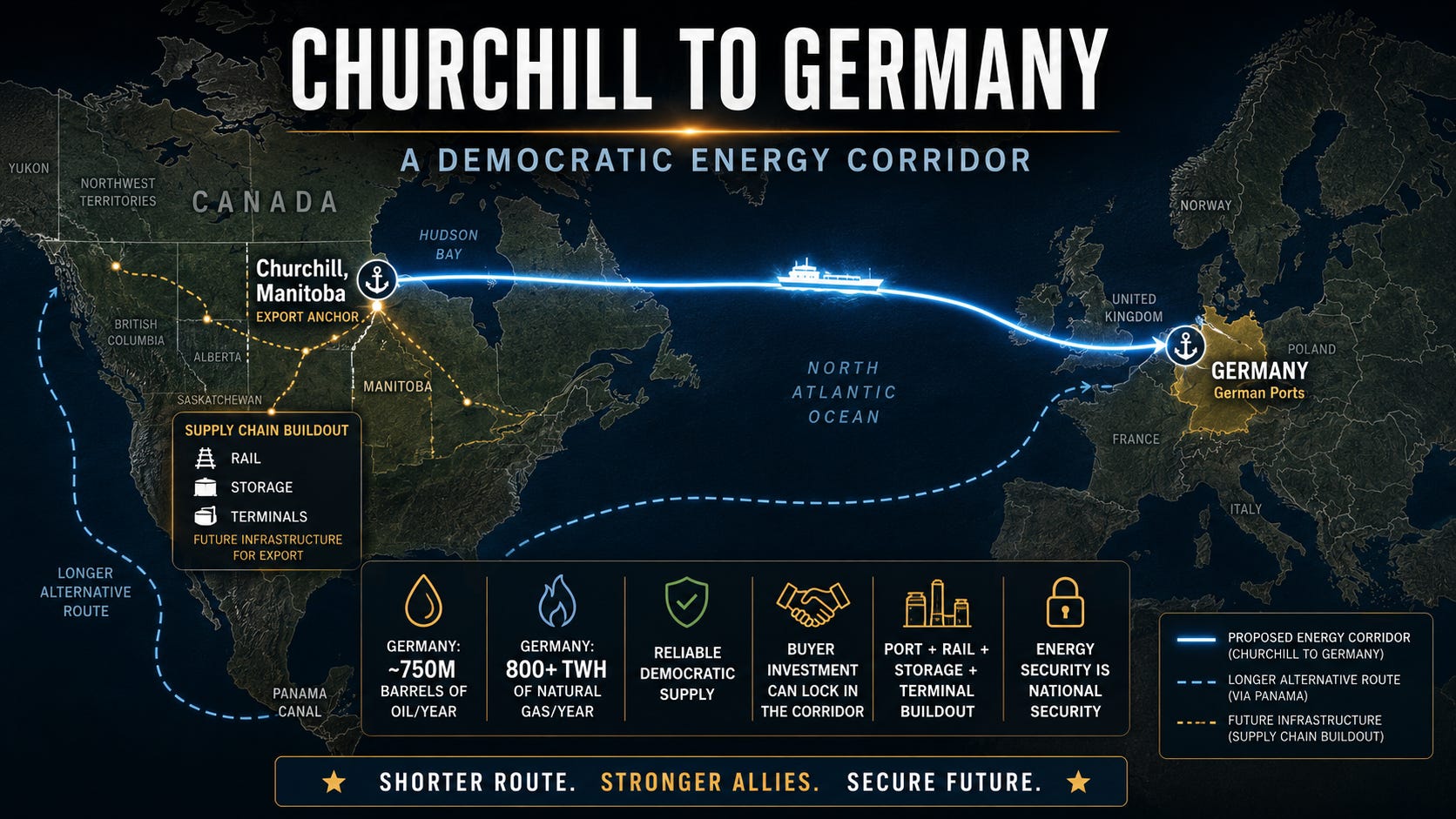
Canada wants to become an energy superpower. The time to become one is already here.
Energy superpowers do not extract resources, wait for buyers, and hope the market notices. They build corridors. They lock in customers. They turn ports, rail, storage, capital, shipping, insurance, long-term contracts, and national strategy into power.
The world has changed. Nations are no longer waiting for perfect conditions. They are building supply systems before the next crisis hits.
For decades, the assumption was simple. The United States would keep the sea lanes open. The Gulf would keep energy flowing. Europe could build its industrial model around imported supply. Markets would absorb the shocks. Politics would eventually calm down.
That world is gone.
Russia already taught Europe what energy blackmail looks like. The Strait of Hormuz has reminded everyone how quickly maritime risk can become economic risk. China is watching every weakness in the Western system. And American politics has become too volatile for allies to treat Washington as a stabilizing force in the global energy order.
That means energy is no longer just a commodity.
It is national security.
The question is no longer who can sell the cheapest barrel or the cheapest cargo of gas. The question is who can guarantee supply when the world gets ugly. Who can keep factories running. Who can keep homes heated. Who can keep allies supplied without asking hostile states, unstable routes, or politically unreliable partners for permission.
That is where Canada enters the picture.
Canada is not just a resource country in this environment. It is a democratic supply base sitting across the Atlantic from a Europe that needs reliability, scale, and political trust.
Germany understands this better than most. It spent years building industrial strength on energy assumptions that collapsed in real time. It now needs supply routes that are not built on wishful thinking.
Canada can offer that.
India just showed what countries do when the world changes. Prime Minister Narendra Modi’s UAE visit was not just a diplomatic stop. India used the moment to pull the UAE deeper into its energy-security architecture.
Strategic petroleum reserves entered the picture.
Long-term LNG supply entered the picture.
Ports, shipping, defence, finance, and technology entered the picture.
And buried inside the package was the most revealing detail: India and the UAE agreed to work on a ship-repair cluster at Vadinar in Gujarat.
That is the giveaway.
India does not need the UAE to teach it how to repair ships. India is one of the world’s largest economies. It has shipyards, engineers, ports, capital, and a state capable of building large infrastructure when it chooses to move.
So why was ship repair sitting inside an energy-security package?
Because the real subject was not repair. The real subject was the corridor.
India was not merely buying energy from the UAE. It was pulling the seller into the machinery around the energy relationship: tankers, LNG carriers, port services, offshore fabrication, dry docks, maritime labour, shipping routes, and the industrial system that keeps fuel moving when the sea becomes dangerous.
That is how countries think now. They do not just buy molecules. They build the system around the molecules.
That is the lesson Canada should take from the India-UAE deal. The transaction is not the prize. The corridor is the prize.
India gave the UAE a stake in the route. Canada should now flip the model with Germany.
India pulled the seller into the buyer’s infrastructure. Canada should pull the buyer into the seller’s infrastructure.
That is the heart of the proposal.
Prime Minister Carney should invite Germany to co-build a Canada-Germany energy-security corridor anchored through Churchill, Manitoba.
As a hard strategic package.
Germany needs reliable democratic energy. Canada has the resources, geography, political stability, and alliance credibility to provide it. But the relationship should not stop at supply. Germany should be invited into the route itself.
Port development. Storage. Rail. Terminals. Shipping. Insurance. Long-term offtake. Export finance. Industrial participation. Arctic logistics. Maritime services.
The whole system.
That is how Canada turns Germany from a customer into a stakeholder. Canada should not simply ask Germany to buy Canadian energy. Canada should ask Germany to help build the democratic route that carries it.
Germany is the right partner because Germany has the problem Canada can help solve. Germany consumes roughly 750 million barrels of oil a year and more than 800 TWh of natural gas. It is one of the industrial engines of the democratic world. It needs durable democratic supply.
That is the opening.
After Russia’s energy blackmail, Germany knows what it means to build an economy around dangerous assumptions. It knows what happens when cheap supply becomes strategic vulnerability. It knows what happens when energy policy is treated as a market issue until the market turns into a weapon.
Germany is now looking for supply it can trust. Canada should be the country that steps forward with a complete answer. The East Coast port in Churchill, Manitoba can be part of that answer. Maybe Churchill, or maybe somewhere else. As long as it sits on the east coast, the answer is good.
Churchill gives Canada something rare: a northern port with Atlantic-facing energy logic, a national-development story, a security story, and a way to connect Canadian resources to European demand.
Churchill does not need to be perfect today. It needs to be made central. Germany helps build the port. Canada figures out how to get things to Churchill.
This cannot be announced as a memorandum and left there. It has to be a package. The starting point should be a long-term Canadian oil and gas offtake structure with Germany. Then Germany should be invited into the buildout.
That is how the corridor becomes real.
Ottawa should not go to Berlin with a brochure. It should go with a map, a financing model, a buildout sequence, and a political ask: help us build the democratic energy route that Germany needs and Canada can supply.
The package should also include a permanent Canada-Germany energy-security council.
Not one announcement. One system.
If German capital helps develop Churchill, German firms participate in the terminal structure, German insurers help price the corridor, German banks help finance the buildout, German companies sign long-term offtake agreements, and German officials treat the route as part of their own energy-security planning, then Canada is no longer just one supplier among many.
Canada becomes part of Germany’s strategic architecture.
That is the difference.
Customers can leave. Co-builders stay.
That is the lesson from the India-UAE model. It gave the UAE a role inside the infrastructure around the relationship. That creates memory, ownership, institutional attachment, and something for both sides to protect.
Canada should do the same with Germany.
A Germany with secure democratic supply is harder to blackmail. A Canada that can supply major allies is more powerful, more relevant, and more secure. A democratic alliance that can trust its energy routes is stronger than one that has to beg unstable regions, hostile regimes, or politically unreliable partners every time the world shakes.
Prime Minister Carney should put this on the table with Germany now.
Canada has the resources. Germany has the demand. Europe has the strategic need. Churchill gives the country an anchor. The democratic world needs secure energy corridors that do not run through chaos, blackmail, maritime panic, or political humiliation.
This is the deal Canada should try to make. Canada should not wait for the world to discover its value. It should organize that value into power.
One corridor. Two democratic pillars. A stronger Canada and a stronger Germany. That is the kind of world I would rather have my children inherit.
Your support for Concis Canada is critical in moments like this.
Individual paid readers help us dig deeper, investigate harder, and reach more Canadians with the strategic analysis shaping the country’s future.
For institutional readers, the Foundational plan is the right level of support. It helps us track more policy signals, test more recommendations, follow strategic files, and produce sharper analysis before key decisions are made.
Individual readers keep this work moving. Foundational readers help us scale it.
It’s easy for me to sit here on my sofa as an armchair critic, but I’d like to see the PM move more quickly on some of these things. I understand that CUSMA negotiations are lurking in the corner. But at some point, we are going to have to stop worrying about that in the context of how it affects our actions in moving forward with the rest of the world. I guess we’re getting there - just a little more slowly than we’d like.
One really great thing? Wab Kinew is one of the greatest wing men I have ever seen or heard. He is an amazingly articulate orator for the support of Churchill and the road to get there.
Setting up an export hub in Churchill makes sense: to route Alberta's and Manitoba's natural gas to Europe through Churchill would be great.
But also setting up an hub in Quebec (Tadoussac) / New Brunswick/Nova Scotia (Halifax) would provide export facilities not subjected to difficult winter conditions. The main problem: no large capacity gas/oil pipelines on sovereign Canadian soil at this time, the Energy East pipeline cancelled in 2017.
So, fully agree on setting up an export hub in Churchill. But also let's go on with gas/oil pipelines going east as to open export hubs on the East coast in order to set up export facilities intended to all European nations seeking to have secure supplies.
Ref: https://ft.maps.arcgis.com/apps/webappviewer/index.html