
Tariffs, 50% tariffs. Canada has options.
Big beautiful options

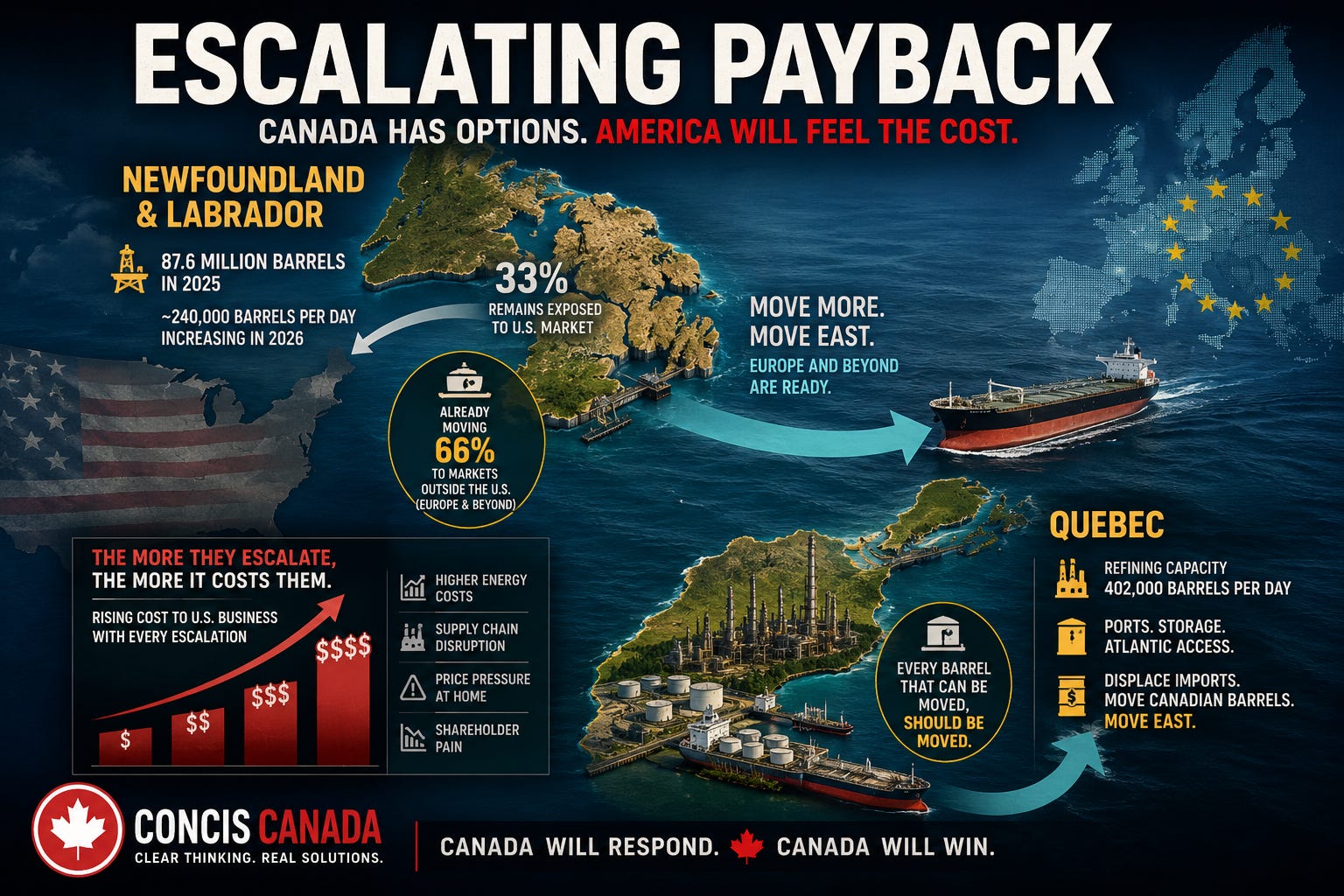
One day before the Trump–MAGA–oligarch administration announced its legally dubious 50% tariffs on Canada, we posted this note on Substack.
Why did the Maga emperor attack China?
We tried everything. We bullied everyone. Nothing seems to be moving. My numbers keep sinking.
So, we are starting over.
Yeah. It is a do-over.
Thanks to the hapless and hopeless Democratic Party in the United States, the odds are now fairly high that Trump will drag the tariff circus back into the centre of the midterm campaign.
Bullying. Illegal tariffs. Manufactured enemies. Economic pain exported straight into American households.
That is now an electoral strategy.
The entire world would be better off if more countries embraced the Indian approach, which in effect told this administration: there is no deal, there is no negotiation, and we are walking away. Add as many tariffs as you like.
Sadly, not many countries have India’s economic cushion. Its long growth run and deep financial reserves give it room to absorb damage that would cripple smaller economies.
But even then, the choice was not painless.
India had to accept severe losses in some industries—exactly the pain the Trump administration expected would force it back to the table. Instead, India said it was prepared to take the hit rather than keep searching for a middle ground that did not exist.
That response appears to have scrambled the administration’s thinking.
We doubt it will try to pull India back into the same net this time. The more interesting question is how deeply the psychological damage from that refusal has settled inside the administration.
We will know in the next few weeks.
The Democrats could still stop the expansion of this strategy if they moved first, named it clearly, and hit the ground hard. But no part of the party appears willing to change.
And that is the environment Canada now faces. Canada is no longer simply a trade target. It has become part of the MAGA–oligarch midterm strategy of hate, attack, and distraction.
What Canada needs is a response that is contingent on American behaviour, but one that also makes it unmistakably clear that the runway for this strategy is not unlimited.
The objective is not retaliation for its own sake.
The objective is to create a steadily rising cost for the large businesses and shareholders that underpin the political machine driving these policies. They need to see the cost climbing on their side of the ledger.
Newfoundland and Labrador deserves a much closer look.
Unlike Alberta, its oil already moves through a marine export system rather than being locked into pipelines pointed south. The province produced 87.6 million barrels in 2025, roughly 240,000 barrels per day, with production climbing further in 2026.
More importantly, Newfoundland has already begun doing what the rest of Canada keeps talking about. By late 2025, roughly two-thirds of the province’s crude-export value was going to markets outside the United States, largely in Europe. That leaves about one-third still exposed to the US market.
That remaining share should now be treated as a strategic pressure point.
Ottawa cannot simply seize tomorrow’s cargoes and order them elsewhere. Producers have ownership rights, commercial contracts, lifting schedules, and existing sales agreements. But that does not mean the remaining US-bound barrels are untouchable forever.
Canada should examine how many of those contracts are short-term, how many cargoes are sold on flexible terms, when the longer agreements expire, and what financial or regulatory measures could accelerate the shift toward Europe, eastern Canada, and other overseas markets.
The United States has already withdrawn the tariff treatment it agreed to under CUSMA. Canada therefore has every reason to examine contingent countermeasures that remain in place only until Washington restores compliance.
The objective would not necessarily be to block every barrel. It would be to make the remaining US-bound share progressively more expensive, less reliable, or commercially less attractive if the administration continues escalating.
Quebec should be part of the same strategy.
Quebec does not produce meaningful quantities of crude oil, but it has something Newfoundland does not: major refining capacity, storage, ports, and direct access to the St. Lawrence and the Atlantic.
That makes Quebec a processing and routing hub.
Ottawa should identify every barrel that can be moved from Newfoundland and Labrador or Quebec, and push as much of that supply as possible toward Europe or other overseas markets from Canada's eastern seaboard. The question is not simply whether Newfoundland can send more oil to Europe. It already has.
The larger question is whether Canada can build a connected Atlantic energy strategy around Newfoundland production, Quebec refining and port capacity, and long-term European demand.
That would give Ottawa more than a temporary retaliatory tool. It would give Canada a permanent escape route from American dependence. Canada does not need a sprawling list of symbolic countermeasures.
It needs one sharp bite.
One measure that makes the largest shareholders financing the MAGA political machine understand that every additional escalation will place a larger cost on their side of the ledger.
This time… the bite better lands on the oil side of the ledger.
Canada does have options - perhaps one of them would be to reduce American ownership of Canadian media. That could be a decent place to start.
Shankar A huge natural gas reservoir found offshore TNL...
If brought into production with a few LNG facilities in Labrador or Newfoundland could be a major boost out of the US and feeding Europe...
https://newsletter.doomberg.com/p/new-found-gas