
The Divide Comes Next
Five Targets

A major American bank CEO called the U.S.–Canada trade dispute a bump in the road. Meaning, you cross the bump and life goes back to where it was. A well-known American author made the same argument in softer language: the U.S.–Canada relationship has a long history, and it will continue long after Trump is gone.
That sounds comforting.
It is also almost certainly wrong.
Before the MAGA–oligarch administration started playing tariff roulette, nearly 100% of Canadian gas exports moved in one direction: south. Now every single mtpa of Canada’s future LNG production has already been booked by European and Asian buyers. Those bookings alone would push the U.S. share of Canadian gas exports down into the 55% to 65% range.
And Canada is nowhere near done expanding LNG production.
So tell me something. How exactly does the supply chain go back to where it was in 2024? Is that even possible?
For five long years, Canada stalled Sweden’s Saab. Saab kept asking: can we build together? Canada kept answering with silence. Last month, the resistance broke. Canada will now build Saab early-warning aircraft. Recent reports indicate NATO is preparing a large order for Saab early-warning aircraft, with at least a dozen currently required. If Canada becomes the production base, that is not a bump in the road. That is a structural shift.
So tell me something else. Will Canada ever go back to its pre-2024 surveillance posture, where it relied on the United States to help it see over the horizon and track hostile threats?
Nope.
Canada is now moving to build its own capability. It has clearly taken the surveillance gap seriously. It has also ordered Australian over-the-horizon radar. That is the right decision, because unless you can see deep, you will not survive a drone-and-missile war.
So this is not just about CUSMA, the U.S.–Canada–Mexico trade deal.
Parts of NORAD, the binational security architecture between Canada and the United States, are also being rearranged. Not abolished. Not broken overnight. But rearranged. And once supply chains, energy routes, surveillance systems, and defence production lines start moving, they do not simply snap back because someone in Washington says the bump is over.
The Canadian ship had already left the American harbor before yesterday’s U.S. decision to keep CUSMA trapped in constant, rolling negotiations.
That is the clarifying moment.
It tells Canadian companies that relief is not coming. The old trade channel is not coming back in the form they knew. If they want a better future, they need to find new channels, or at the very least rebalance their exposure to the United States.
That gives them clarity. It ends the old question: can this be fixed? The answer is now obvious. Canada has to build beyond it.
What is the United States likely to do from here?
The first move will be to try to divide Canada and Mexico.
If Canada and Mexico can hold together, they make life much harder for the MAGA–oligarch administration. But that is easier to say than do. Every day, Washington will look for openings. It will offer one country relief, pressure the other, create side channels, and test whether Ottawa and Mexico City can stay aligned.
A lot will depend on how Mexico decides to play it. That is hard to predict. But Carney needs to keep his channels with Mexico open, steady, and serious.
Is there any reason Canada is being targeted?
The reality is that this is not just about Canada.
The oligarch administration is trying to pull every major trading partner into its tariff net because it needs revenue to fund the billionaire tax-break bill it passed last year.
That is why the five countries in the table below matter. This is where a large share of the tariff money sits.
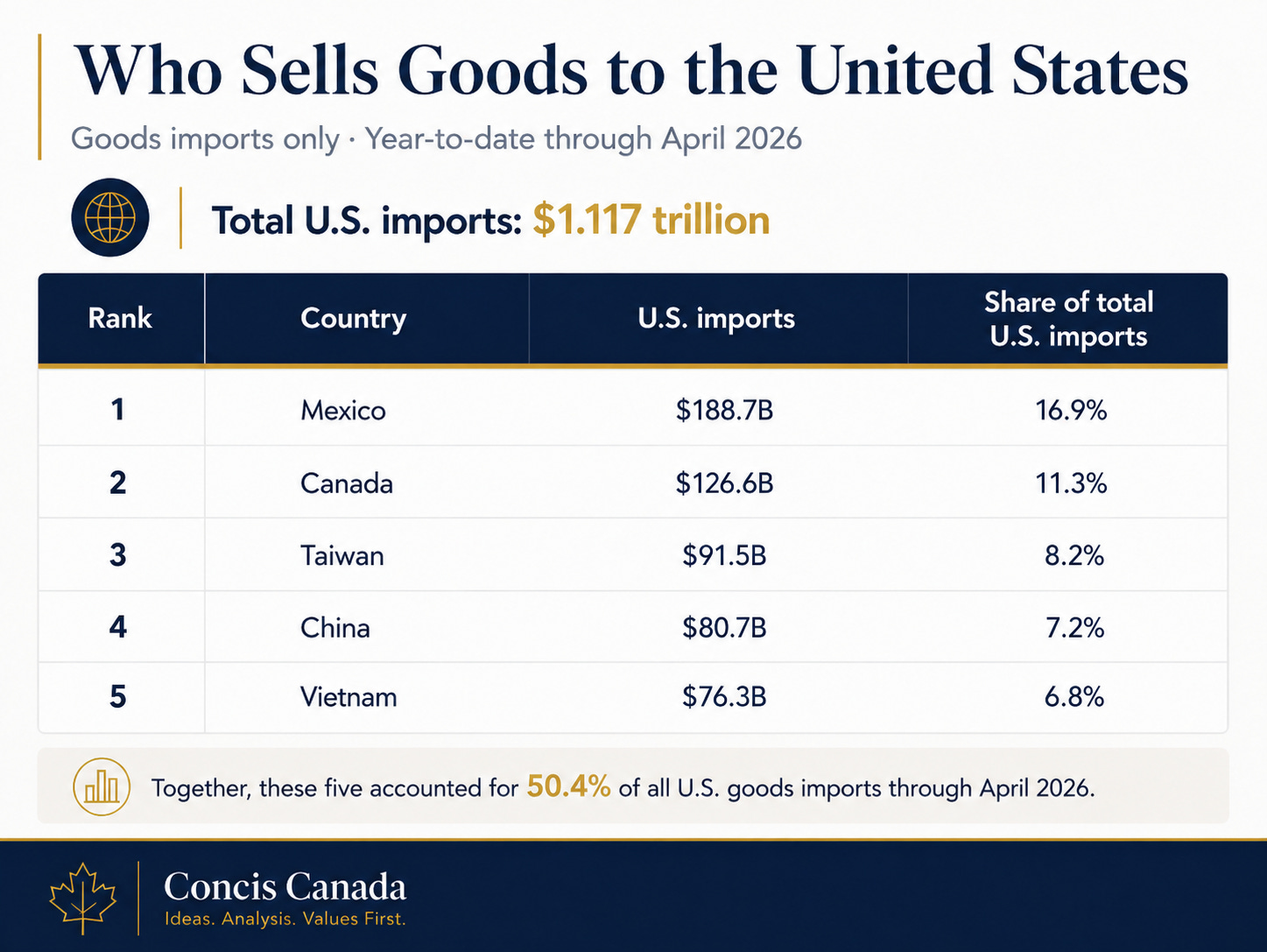
If Canada and Mexico can stay aligned, they can push back with real force. Separate, they are easier to pressure. Together, they make the cost of Washington’s tariff game much higher.
They have already tried to separate Mexico and Canada, and we have responded by starting to negotiate a separate deal with each other.
I am very excited about the PM's major announcement with BC's Premier Eby. Not just several LNG projects: a clean energy corridor between Prince George and Terrace, copper mine expansion, badly needed infrastructure ( Massey Tunnel - currently an alternate lane closing chokepoint nightmare), port expansion of Prince Rupert and Stewart (and if you've ever been to Stewart you'd know how amazing that will be tucked up there under the Panhandle) but best of all, no lifting of the North Coast oil tanker ban. That means if Alberta wants another bitumen pipeline they're going to have to work hard to convince provinces to the east and start feeding the East Coast refineries and Port of Montreal, or possibly Churchill.
Maybe you could explore this agreement in a future post in your inimitable fashion Shankar.