
Why Is Canada Still Dragging Its Feet on the Gripen?
It's complicated.

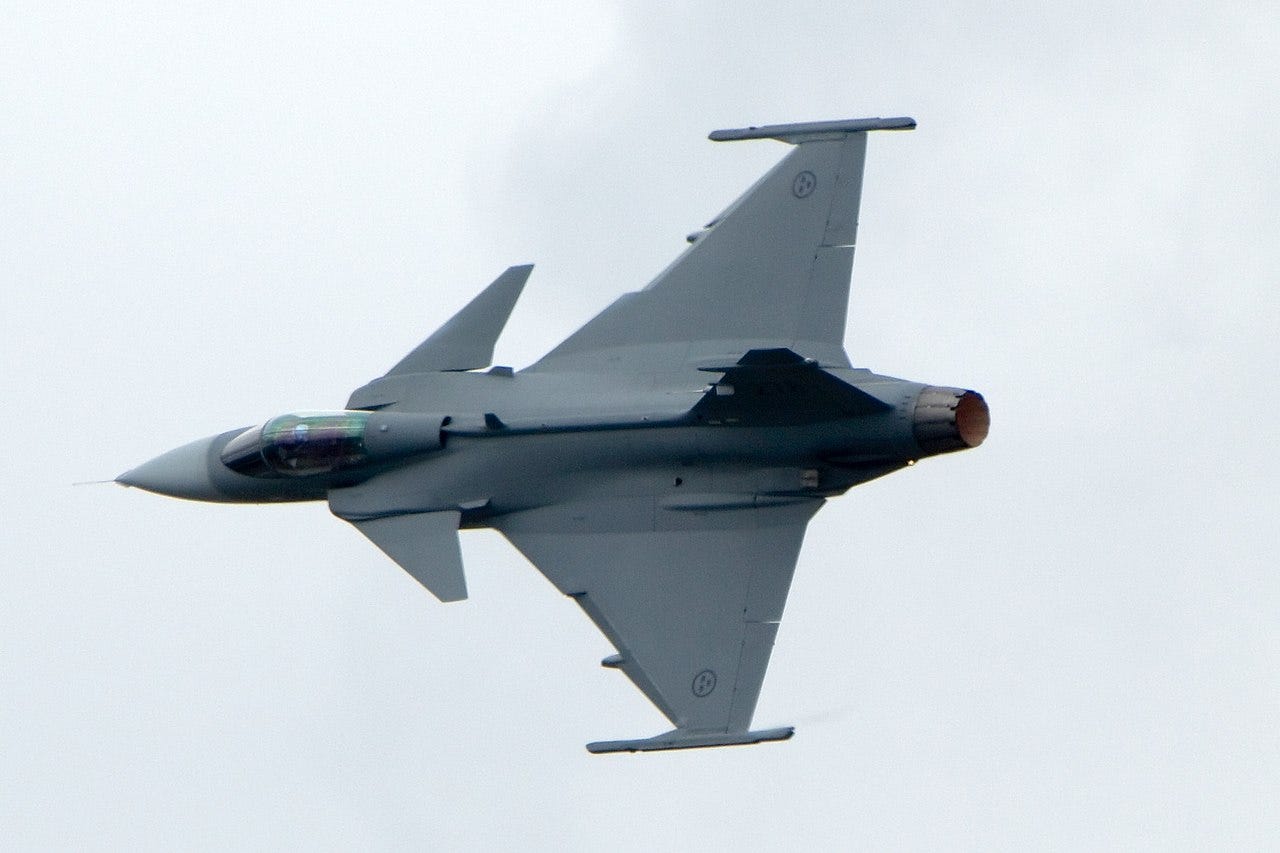
A month ago, if I had written this piece, I would have started with a simple question: what is there not to like about the Swedish Saab Gripen? From there I would have walked into the long arc problem of remaining tied to American fighter jet programs. Then I would have moved on to the French Rafale — praising its capabilities while complaining about its abysmal production rate and high cost. And eventually I would have circled back to the Gripen and the advantages it offers Canada.
I can’t do that now.
The Rafale is still a highly complex and fairly expensive beast. But its production constraints are about to change. France is on the verge of signing a monster deal with India, one that will almost certainly involve local production. Once that line is running, Rafale output will no longer be stuck at the painfully slow pace we see today. With Indian production potentially reaching two to four aircraft per month, Canada — if it truly wanted to — could realistically consider the Rafale.
But I wouldn’t recommend that path.
Because Saab needs partners to march toward the next generation of fighter aircraft, and they have clearly identified Canada as one of the countries capable of walking that road with them.
France will work with India to evolve the Rafale into its next iteration. Sweden, meanwhile, wants to build that future with Canada.
Which means Canada actually gains far more by choosing Saab’s Gripen than by buying into the Rafale ecosystem.
There is a lot of chatter about fighter jet platforms around the world. But if you look at where the market is actually heading, the field is narrowing quickly. The real competition is tightening around three aircraft: the American Lockheed Martin F‑35, the French Dassault Rafale, and the Swedish Saab Gripen.
For Canada to have a meaningful hand inside that fighter ecosystem would be enormous. Opportunities like that do not appear often. In fact, they tend to appear once every few decades. Miss it, and the window is gone for good.
So why on earth would Canada — despite Sweden actively courting Ottawa for months — continue to stall?
Why not greenlight the future?
Why not loosen the American lock on Canadian defense procurement, especially when the current administration increasingly treats Canada less like an ally and more like the next meal on the table?
Well, because there are problems.
Big ones.
And they sit quietly behind the screen.
Canada is in NATO. The United States is also in NATO. Then why did they build a separate command just for North America — NORAD? Because NATO was never designed to defend the North American continent itself. It was built to defend Europe.
In 1958, the United States and Canada formally created the North American Aerospace Defense Command (NORAD). It became a binational command, meaning officers from both countries operate within the same command structure. This was not simply cooperation between two militaries, but a single integrated defense system.
During that period, staff officers from the U.S. Continental Air Defense Command and the Royal Canadian Air Force met to address the growing threat of Soviet long-range bombers.
“The outcome of that meeting was a recommendation to the United States and Canada that we could counter that threat more effectively if we combined our forces and formed an integrated binational command—something completely unique, but built for that purpose.”
This holds true at every level you can think of.
Once Canada adopts the Gripen, the slope becomes very slippery for the United States.
Because weapons ecosystems rarely stay static. One procurement decision leads to another. Over time the composition of Canada’s arsenal could gradually shift from being overwhelmingly American to something far more diversified.
And once that shift begins, the strategic math changes.
At some point in the future Canada could find itself in a position where it starts asking uncomfortable questions about North American Aerospace Defense Command (NORAD). I know that sounds far-fetched at first.
But does it really?
Europe is already moving in that direction. Through the Security Action for Europe (SAFE) programme, weapons production is being standardized across Europe to increase interoperability and reduce dependence on external suppliers. Canada is the only country outside Europe that has signed onto that framework.
Which means something important: European and Canadian defense industries could begin aligning far more closely with each other than either of them align with Washington.
And Europe is not blind to the political signals coming from the United States. European leaders know exactly why this administration shows such warmth toward Hungary. They know why J. D. Vance chose to meet with Alternative for Germany leaders despite warnings from German Chancellor Friedrich Merz.
Even the administration’s own national security rhetoric increasingly frames global responsibility as optional. If that is the worldview guiding Washington, then the obvious question for allies becomes simple:
Who decides which parts of the world matter?
Seen through that lens, the idea of Canada tightening its integration with NATO while loosening its dependence on NORAD no longer looks impossible.
And if that trajectory begins, Washington has every reason to worry.
Because the moment Canada starts drifting in that direction, NORAD becomes politically fragile. The United States understands that risk very clearly.
Which is precisely why Washington will fight hard to keep Canada firmly anchored inside the NORAD framework. And one of the easiest ways to do that is to make sure Canada’s air force remains locked inside the American fighter ecosystem.
That means keeping the Gripen out.
To be continued…
Tomorrow we will look at Canada’s options — how it could break the lock, and whether it actually needs to.
Shanker describes the direction of flow and future positioning so well that layman and strategist agree – the move to Saab is a veritable no-brainier.r
Great post, Shankar. Top line thoughts:
- Canada still needs something like NORAD because some part of destiny is geography and Russia will always be tempted to strike out of its confines.
- Canada may need something more because the geographic component of destiny for the US points to the North.
- Canada’s only defense against US military pressure, as revealed by latest war-gaming is asymmetric war - tiny units deep in Shield country, the Rockies, and the North-west passage.
What are Canada’s top-line opportunities to counter US pressure?
- “Porcupine” capabilities supplied by EU and possibly China
- EU nuclear umbrella integration
- NATO with reduced US dependency
The NATO option is clearly the shortest path.
(Apologies for the line-spacing. IOS is cranky today)