
Canada Executes
Kitimat shows what diversification looks like when it finally becomes infrastructure.

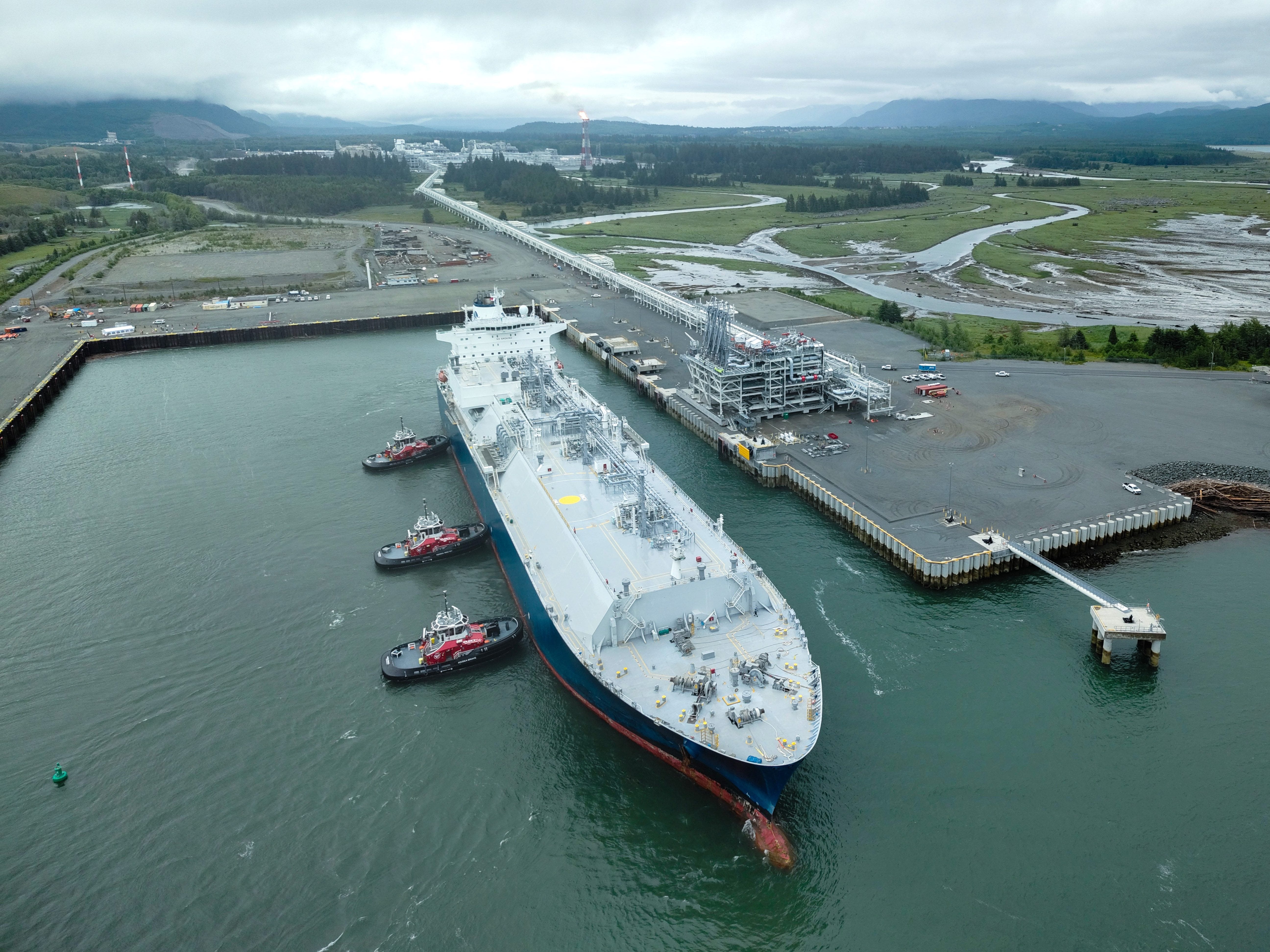
What a way to start a Monday.
LNG Canada exported more than 1 million metric tonnes of LNG in April through the Kitimat facility.
One million metric tonnes of LNG in a month is roughly equal to 1.6 billion cubic feet per day of natural gas. Canada currently exports around 8.8 Bcf/d of natural gas to the United States. So one facility on the British Columbia coast is already moving LNG volumes equal to nearly 20% of Canada’s existing gas exports to the U.S.
And this is only April 2026.
That is the point. This is not a theory anymore. This is execution. Canada has spent years talking about diversification, trade resilience, energy security, Indo-Pacific access, European demand, and reducing exposure to the U.S. market. Kitimat is what it looks like when those words finally become infrastructure, cargoes, ships, customers, and hard numbers.
The Carney government should move quickly to clear the remaining path for Phase 2 of LNG Canada. Phase 1 gives Canada a 14 million tonnes per year export platform. Phase 2 would double that to 28 million tonnes per year, turning Kitimat from a major project into a strategic national lever.
That means one facility in Kitimat could soon run at volumes approaching half of what Canada currently exports in natural gas to the United States.
That is the strategic point.
The recently approved Alberta pipeline is oil, not gas. It is a different file. But the direction still matters because it deepens trade exposure to the U.S. market at the exact moment Canada should be working every cylinder to reduce single-market dependency.
Still, politics requires judgment. Not every risk is worth turning into a fight. This one increases exposure, yes. But instead of spending political capital trying to block one more southbound oil route, Canada should use that same energy to build the alternative.
The better answer is not to lose another internal fight. The better answer is to win the diversification race.
And the cleanest win available is LNG.
Expanding natural gas exports to the world is one of Canada’s strongest strategic paths. At Concis Canada, we have made no secret of our position: LNG Canada sits at the top of the list. Canada should be targeting 4 to 5 Bcf/day equivalent in LNG exports within the next two to three years.
Why?
Because the math changes the politics.
Canada currently sends almost all of its natural gas exports to the United States. Hold that U.S. volume at roughly 8.8 Bcf/day, then add +4 Bcf/day of LNG exports to global markets, and the structure changes immediately.
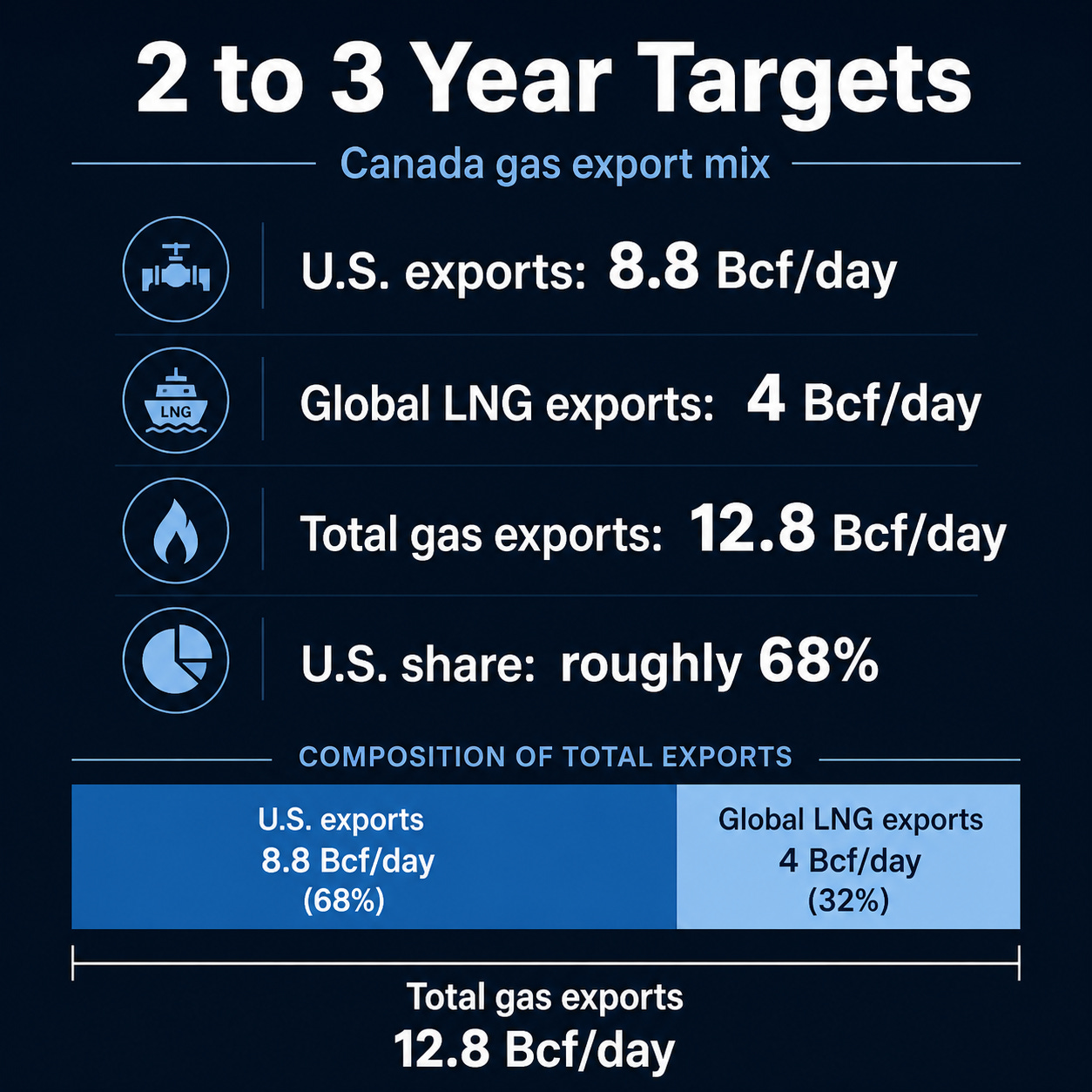
That is the first move. Canada goes from near-total exposure to the U.S. market to roughly two-thirds exposure.
Then the next move becomes possible. Push global LNG exports higher. Add east-coast export capacity. Expand west-coast capacity. Build the infrastructure that gives Canadian gas more than one exit door. Once that happens, the U.S. share can fall below 50%.
The long-term target should be much lower. Closer to 20%.
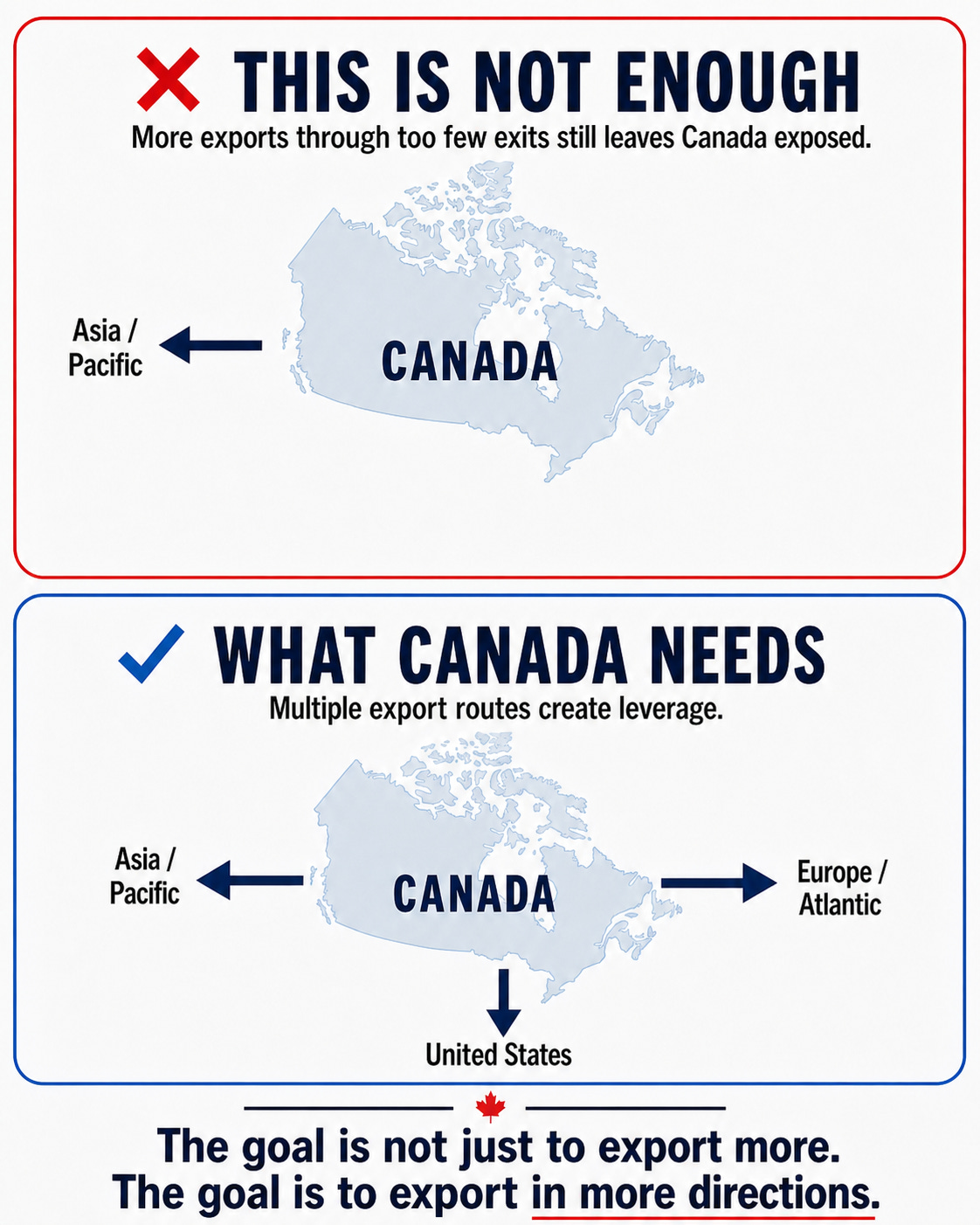
That is not anti-American. This is not pro-European. That is basic strategic discipline. As a business, or as a country, you do not allow any single supplier, any single buyer, or any single route to control your future. Not if you have options. Not if you have leverage. Not if you have learned anything from the last decade.
Canada has options. Now it has to build them.
So yes, this is a long road. Diversification does not happen because one cargo ship leaves Kitimat. It happens because Canada keeps stacking capacity, approvals, financing, customers, and infrastructure until the structure of the economy actually changes.
The trade balance matters first. Every new export route gives Canada more room to sell into global demand instead of accepting the price, pressure, and politics of one dominant market. LNG does not solve the whole trade-exposure problem, but it is one of the fastest ways to start changing the denominator.
The alliance balance matters too. Energy is not just a commodity. It is geopolitical weight. If Canada can supply Asia and eventually Europe with reliable LNG, it becomes more useful to allies who are trying to reduce exposure to Russia, China, and unstable supply routes. That makes Canada harder to ignore.
Execution gives confidence. Governments can announce strategies all day. Markets care when projects actually move cargo, earn revenue, and prove the infrastructure works. LNG Canada crossing the million-tonne mark in a month tells investors, customers, and allies that Canada can still build and deliver at scale.
And movement attracts money. Once investors see capacity opening, buyers signing, ships moving, and governments backing the sector, the next project becomes easier to finance. Industry grows around momentum. Pipelines, terminals, port services, engineering, upstream production, long-term contracts, and local supply chains all become easier when Canada proves the first major project is working.
Your support for Concis Canada is critical in moments like this. It allows us to dig deeper, investigate harder, and keep Canadians informed about the decisions shaping their future. It will help us reach more people across the country and show the world the role Canada plays within the democratic alliance.
Shankar, I can appreciate the argument, but it breaks my heart that our prospects depend on fossil fuel expansion which damages the environment. How I wish we could get away from that dependence and shift the equation to renewables.
Thank you Shankar for your insight.
Our PM is a pragmatist. Imagine the philosophical internal debates he must have had with himself being a net zero guy, environmentalist (as I am) and move hard on fossil fuels like oil and gas, and LNG. The difference is that ours are one of the cleanest in the world. This matters.
India needs heavy energy as it further industrializes away from dirty coal. Other countries as well. We cannot prevent the rest of the world from using fossil fuels, so the next best thing is to use our strongest resource assets, as responsibly as we can, and provide that energy to those emerging economies. We grow our economy away from the USA, gain strength, and also in parallel grow our clean energy transition where possible, so that we can also be a global leader on clean energy initiatives and solutions. In short, we provide both solutions when an emerging country is ready for them. Nuclear, like the CANDU reactors is another way, for like-minded allies.
There is no perfect answer, this is existential for Canada to survive. From that place we can do the important work we need to do as a global leader for democratic values, clean technology, and other important work. We cannot do that work if we do not survive. Hard choices, but necessary.