
Canada Finds the Exit
The 1 Million Barrel Signal

Wow.
They were ready with the loaded gun.
As soon as the MAGA administration played the much-expected “we are not renewing CUSMA” card, the Carney administration dropped a massive set of energy decisions and forced the western media to look away from the U.S.–Canada trade talks.
We, for one, are not complaining at all.
Bloomberg read the move as an infrastructure-finance story. The Financial Times read it as a geopolitical-economic story: Canada trying to reduce its dependence on the United States by turning the Pacific coast into an oil and LNG export platform. The Wall Street Journal stayed a little more mechanical. But all three did not miss the central number:
One million barrels of oil per day to the Pacific coast through southwest British Columbia.
That is Canadian oil finding an exit to the west.
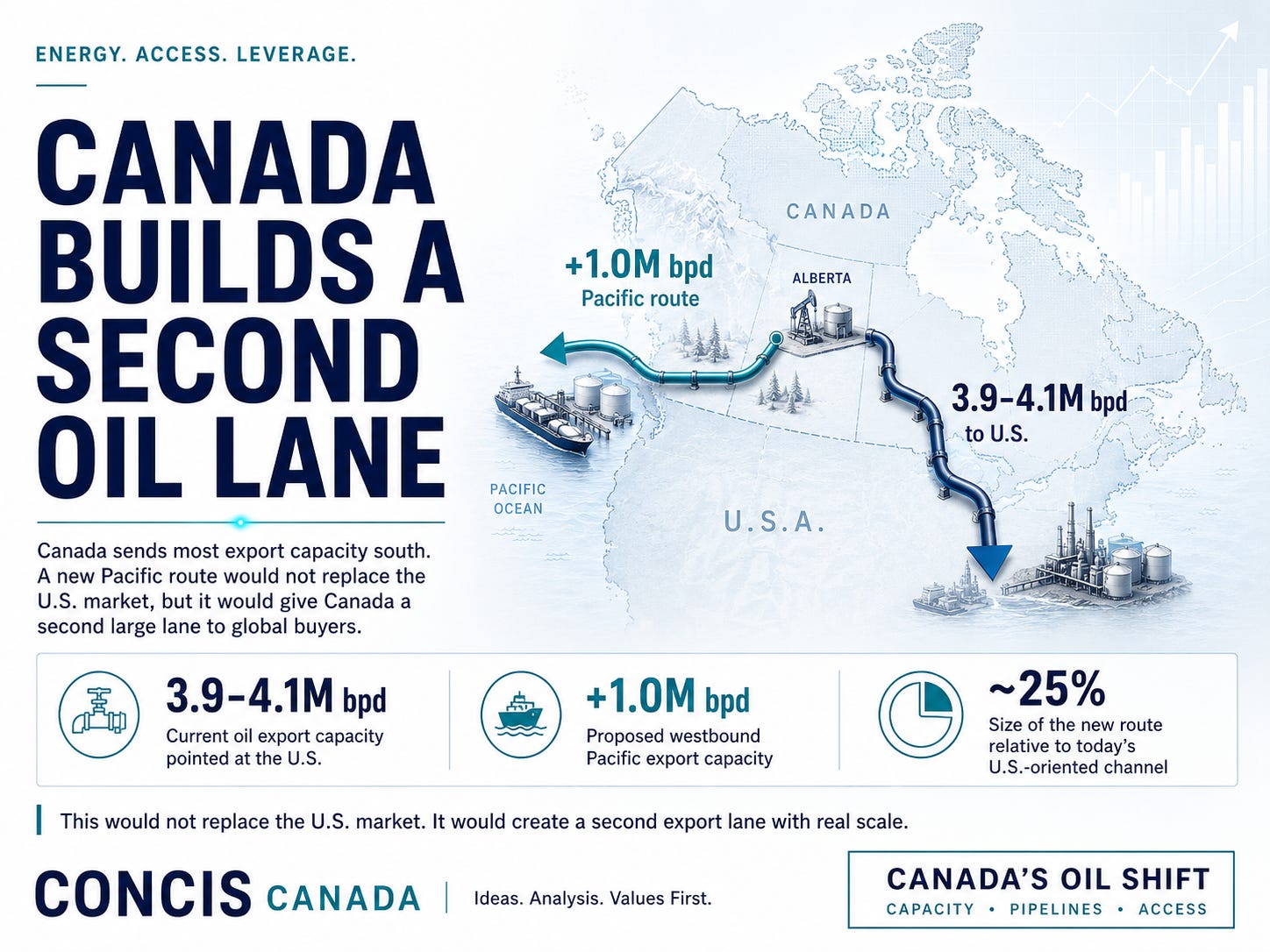
Canada currently exports roughly 4 million barrels per day to the United States. The new pipeline would add 1 million barrels per day of export capacity. That does not mean 1 million barrels per day of new oil on day one. In the early phase, much of it would likely be existing barrels rerouted away from the U.S. market. Over time, it could support additional production if companies invest against that new capacity.
But the strategic point is already clear: This would not replace the U.S. market. It would create a second large export lane with real scale.
And oil was only one side of the package.
Until yesterday, it was not fully clear when Canada would move seriously on LNG Canada Phase 2 at Kitimat. Phase 1 is already delivering gas and carries about 14 million tonnes per year of LNG capacity. Yesterday, Canada said out loud that it will back Phase 2, which would add another 14 million tonnes.
That was expected. But expected is not the same as committed. At some point, the government has to say it clearly. Yesterday, it did.
Then came the second LNG piece: Ksi Lisims.
Ksi Lisims LNG got its feed-pipeline placed inside the national buildout frame. That pipeline is the Prince Rupert Gas Transmission Project, or PRGT. It is the natural-gas artery that would move gas from northeastern B.C. to the proposed Ksi Lisims LNG facility on or near Nisga’a territory on the northwest coast.
This is not a small side component. PRGT is an approximately 900-kilometre pipeline designed to supply the feed gas for liquefaction at Ksi Lisims.
In plain terms: Ksi Lisims is the terminal. PRGT is the spine.
Without PRGT, Ksi Lisims is a coastal LNG proposal. With PRGT, it becomes part of a full export corridor: gas from the northeast, pipeline to the coast, LNG on the Pacific, and buyers across the ocean.
What Is With the C$200 Billion Number?
The C$200 billion number floating through western coverage is not one project. It is not one federal spending line. It is not a cheque written yesterday.
It is probably the estimated direct-investment envelope for the whole Pacific energy-and-export package: the oil pipeline, LNG expansion, ports, transmission, mines, and related infrastructure.
But we should be careful with it.
Bloomberg and Alberta’s numbers put the new westbound oil pipeline alone in the C$35.2–C$43.7 billion range.
LNG Canada Phase 2 would also be a very large capital project. Phase 1 was already described by Reuters as a C$40 billion project, and Phase 2 would broadly mirror that scale if fully built.
Then add the rest of the stack.
The reported C$10 billion Vancouver port upgrade. The North Coast Transmission Line. PRGT. Ksi Lisims. Cedar LNG. Woodfibre LNG. Red Chris. The related roads, power, port, pipeline, and industrial infrastructure that comes with a buildout of this size.
That total moves quickly.
We can see the path to C$100 billion without much difficulty.
The harder question is whether the already-announced project stack clearly supports C$200 billion, or whether that number includes expected future decisions, associated private investment, and wider industrial buildout that has not yet fully landed.
So the safer way to read it is this: C$200 billion is the size of the ambition. It is not yet the size of the locked-in build.
That distinction is important. Canada has clearly moved from speeches to project selection. The oil route has been named. The LNG priorities have been named. The port and transmission pieces have been pulled into the same frame.
But there is still a difference between a national investment envelope and fully financed, fully permitted, shovel-ready construction.
And that is where the real story sits. Yesterday was not the end of the process. It was the moment Canada put the western export machine on the table and told everyone what it wants to build.
3.5 billion for the North Coast Transmission line
500 million for the Red Chris Mine which will increase copper production by 15%.
10 billion to increase capacity for VLTS at Roberts Bank terminal
3 billion to replace George Massey tunnel
All designed to sweeten the deal for the BC NDP government because they could not or would not have the ability to do that work themselves.
As well with this new line following the same layout as the previous line is does not impact the area of our coast that is closed to tankers.
As an environmentalist, I’m not happy about this, but I am also a realist who understands we need to rebuild our capacity to function as a fully sovereign country and we must use the natural resources we have to achieve the status of energy superpower and to remove our reliance on a single unreliable trading partner!
Yes APAC, EMEA, and LatAm are the future for Canada. The sooner small-minded Canadians realize this, the better we are in the long-term. Americans do not see much in Canada other than another small market to dump their goods and services in, after all.