
Canada Picks Germany
Canada’s submarine choice is not just a procurement decision. It is a strategic pivot toward Germany, NATO’s northern flank, and the long-overdue rebuilding of Canada’s Arctic architecture.

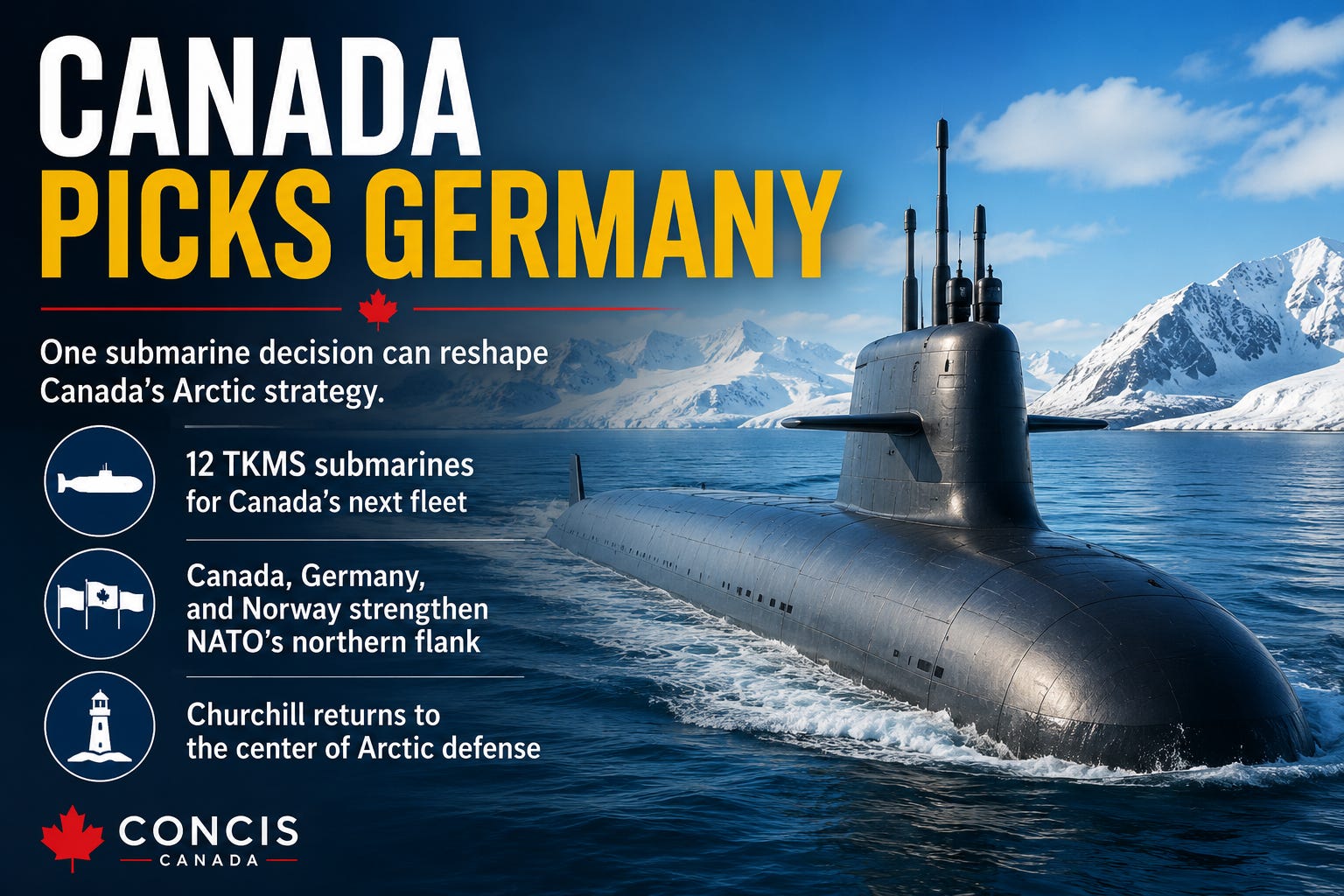
Since this morning, as I kept working, there was one constant background hum: what is Canada going to do?
It was tense. It still is. Until we hear Prime Minister Carney say it out loud, nothing is final. But leading media outlets are now reporting that Canada has made its choice: Germany’s Thyssenkrupp Marine Systems will build Canada’s new submarine fleet.
Can a fleet of submarines be that important?
Yes.
Because this is not just a fleet. This is a pivot. A break. A starting point. One deal that can set the stage for a much larger strategic surge. We will talk about it today. But this one needs more than one story. It needs more research, more mapping, and probably at least four deep reports to properly explain the consequences of this deal.
Because we are not just looking at a submarine order.
We are staring at the beginning of a cascade — a new chain of Canada-Germany defense, industrial, Arctic, and NATO moves that can strengthen the relationship for decades.
The first effect is political.
This connects directly to the growing Canada-Germany relationship. Canada is not just buying submarines from a vendor. It is choosing a long-term strategic partner inside Europe’s defense-industrial core. That gives Ottawa and Berlin a serious project to build around: procurement, training, maintenance, Arctic security, industrial cooperation, and NATO planning. One contract can become the spine of a much deeper relationship.
The second effect is industrial. Canada’s reported 12-submarine order would be a major win for TKMS on its own. But if India also moves forward with its separate six-submarine P-75(I) program with TKMS and Mazagon Dock, then TKMS is staring at a possible 18-submarine wave across Canada and India alone. Add Germany and Norway’s own Type 212CD program, and the company is no longer just competing for contracts. It is becoming one of the central conventional-submarine houses of the next decade.
The third effect is operational.
If Canada, Germany, and Norway are all moving around the same submarine family, NATO gets a northern-flank cluster. Training becomes easier. Maintenance becomes easier. Spare parts and upgrades become easier. Doctrine becomes easier. Undersea operations in the Arctic, the North Atlantic, the Norwegian Sea, and the GIUK gap become easier to coordinate. Canada does not just get submarines. NATO gets a more coherent undersea architecture in the north.
The fourth effect is Canadian infrastructure.
This deal should reopen the Churchill question in Manitoba. Germany has already expressed willingness in helping Canada build the port. Churchill is complicated. That is exactly why Canada should order a massive research to identify how it wants to build the port.
It cannot just be treated as a port.
We have made our position on Churchill extremely clear.
Churchill cannot be treated as a port alone. It has to be studied as a seasonal export hub, a naval support node, an Arctic logistics point, and part of a wider northern defense architecture. That means an airbase or upgraded northern airfield nearby, layered surveillance, rail, storage, fuel, repair capacity, emergency response, and security infrastructure.
The complication is real. But that is exactly the point.
If Canada can pull this off, Churchill becomes more than a difficult northern project. It becomes a defensive node that creates one hell of a complication for any enemy looking to target Canada, the Arctic, or the democratic alliance.
I am mightily relieved.
Looking forward to the rest of your analysis. Especially wrt trade offs vs the competing bid. “True North strong and free “ just got a backbone.