
Carney Takes the Majority
Hungary broke through. Carney followed. Two majorities, two chances to actually govern.


As I watched Hungary’s election results come in over the weekend, the Tisza Party kept hovering at the edge of the two-thirds majority it needed to force structural reform. It was already on course to form a government. But for hours, it looked as though it could still fall one or two seats short of the parliamentary threshold required to actually rewrite the system.
That is the line that decides whether a victory changes a country or merely inconveniences the people who broke it. I found myself thinking: please do not end up where Canada did, close enough to win, but still too short to break obstruction. A few seats can be the difference between governing and spending years watching the opposition sabotage every serious attempt at progress.
This time, Hungary cleared the line. Tisza won the supermajority it needed to get things done. Then, one day later, Mark Carney’s Liberals moved from minority to majority control in the House of Commons after by-election wins and recent floor crossings.
The threshold is 172 seats in a 343-seat chamber, and the Liberals are now above it.
The biggest change is simple: Carney no longer needs opposition votes to govern day to day. Under a minority, every budget, confidence vote, and major bill can turn into a negotiation or crisis. Under a majority, the government can usually pass legislation on its own, keep tighter control of timing, and reduce the risk of being dragged into an early election.
For the government itself, this helps in three direct ways.
First, gives Carney governing stability. Ministers and the civil service can plan around a longer horizon instead of constantly counting votes.
Second, it gives the prime minister more leverage inside his own party and caucus, because MPs know the government is not surviving by one or two swing votes.
Third, it makes it easier to push through a coherent program instead of trimming every bill to satisfy another party’s demands.
For Canada, the main benefit is decision speed and policy continuity. In a minority parliament, governments often move cautiously because almost every controversial move risks parliamentary defeat. A majority lowers that friction. In a period shaped by U.S. trade pressure, defence debates, industrial policy, and infrastructure bottlenecks, that can mean faster execution and a clearer national line.
Trade and economic policy: If Carney wants to respond to U.S. tariffs, economic coercion, or supply-chain pressure with tax, industrial, procurement, or emergency-support measures, a majority makes those moves easier to pass and easier to sequence. It also gives businesses more confidence that the policy line will not collapse after one close vote.
Defence and Arctic policy: A stable majority gives the government more room to make long-horizon decisions on spending, procurement, Arctic infrastructure, and sovereignty posture.
Budgeting and fiscal planning. This is a major one. Minority governments can survive by stitching together one budget at a time. Majority governments can build multi-year spending plans with less parliamentary risk.
Infrastructure and industrial policy. Big projects often need enabling legislation, appropriations, regulatory changes, and political staying power. A majority gives Ottawa a better chance of moving on housing, transport, energy, defence production, and internal trade reforms without repeated opposition bargaining.
There are also spill over effects. A Carney majority weakens the opposition’s ability to force concessions, raises pressure on Pierre Poilievre and the Conservatives, and could pull Canadian politics toward Carney’s preferred center of gravity for several years.
One of our readers asked what exactly prompted me to start Concis Canada. If money were the objective, the obvious path was U.S. politics. That is where the noise is. That is where the scale is. It is overcrowded, yes, but it is also a field I have spent a great deal of time studying. From the standpoint of my own skill set, it would have been the easiest lane to enter.
But that is not where I went first. We started with Ukraine. The reason is simple: Ukraine is the frontline of the democratic world’s future. If Ukraine is lost, the odds of democratic decline across the wider West rise dramatically. That war was never just about territory. It was always about whether the democratic world still had the will to defend itself before the rot spread inward.
Most people knew what Project 2025 was. Most people could see the authoritarian undertones. But there was still no guarantee the incoming MAGA administration would actually move from rhetoric to execution. Politicians say all kinds of things. Backroom operators want all kinds of things. Until power begins to act, intent remains partially theoretical.
That ambiguity ended when Elon Musk entered the picture. Once he began dismantling USAID and pulling apart parts of the American state, the direction stopped being speculative. It became clear that the MAGA administration, backed by a cluster of billionaires, was not merely flirting with authoritarian instincts. It was beginning to operationalize them.
That was the point when we understood the threat to Canada was real. Not when Trump mocked Justin Trudeau as the “Governor of Canada.” Not when he kept calling Canada the 51st state. Those were signals, and ugly ones. But the real line was crossed when Musk called USAID a criminal organization and then helped put the axe to it.
As of today, USAID is gone.
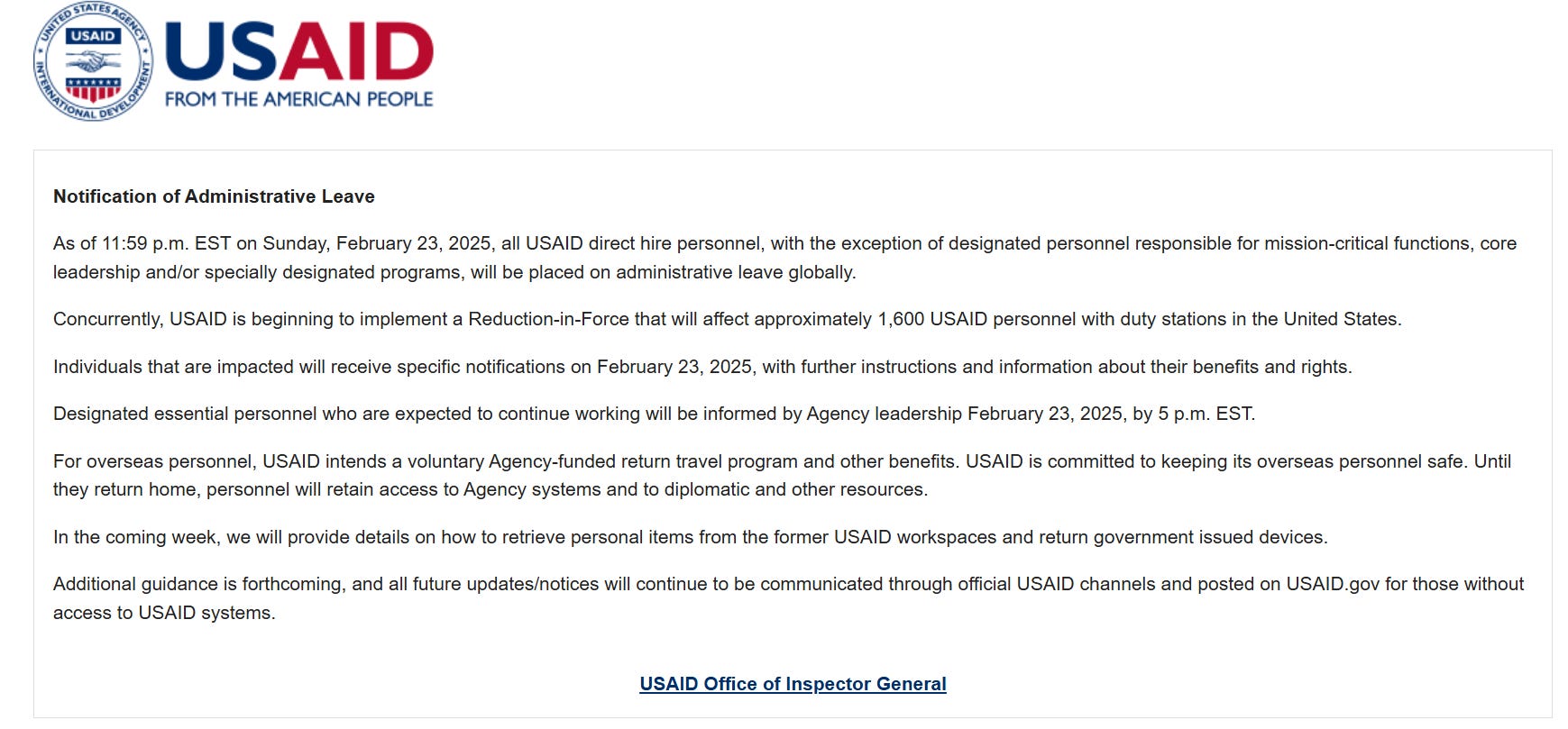
That is an oligarch yanking at one of the threads that still holds a democratic structure together. Keep pulling enough of them, one after another, and the United States can absolutely drift into authoritarianism. And once that process starts inside the empire, the next target is obvious: the democracy next door.
You can already see the outer edge of that machine turning toward Canada. Bottom-feeders from the MAGA influencer ecosystem are crawling out to attack it, distort its politics, and help drag the Canadian right back into power. Their job is to throw dirt at anything the Carney government attempts, to cloud the field, and to keep Canadians trapped inside manufactured confusion.
That fog is not accidental. It is part of the pressure. And that is why I started Concis Canada.
Both Concis and now Concis Canada have become my go-to sources of insightful news analysis. Thank you for clarity in the midst of so much online noise.
It is so important to have your Canadian analysis; it helps counteract the disinformation and provides hope and direction. We are all fortunate that Carney is a capable, ethical statesman and not an inept, corrupt politician. That is making a difference for Canada, but also for the rest of the middle powers (and helps many of us Canadians sleep at night).