
The Tariff Wall Backfired
Trump’s Tariff Wall Is Becoming Canada’s Escape Route.

For a very long time, Canadian aluminium had one obvious destination: the United States. Nearly 2.6 million tons of unwrought aluminium metal and alloys crossed the border last year. Then Trump decided to slap tariffs on Canadian aluminium, and the old logic started to break.
In the first quarter of this year, Canadian aluminium accounted for 54% of U.S. imports, down from 75% in 2024. A good chunk of Canadian aluminium is now heading somewhere else.
Europe.
This is the odd logic of Trump’s tariff wall.
The global aluminium price is roughly $3,670 a ton.
In Europe, tight supply has pushed the delivered cost to about $4,300 a ton.
In the United States, tariffs and scarcity have pushed the effective cost to around $6,200 a ton.
Normally, that kind of price gap would pull Canadian aluminium straight back into the American market. But the tariff changes the calculation. The U.S. buyer may be paying more, but the Canadian producer does not simply pocket the whole difference. According to Gregory Wittbecker of Wittsend Commodity Advisors, the U.S. Midwest premium would need to rise to at least $2,645 a ton, before Canadian producers would have a strong enough reason to divert supply back from Europe.
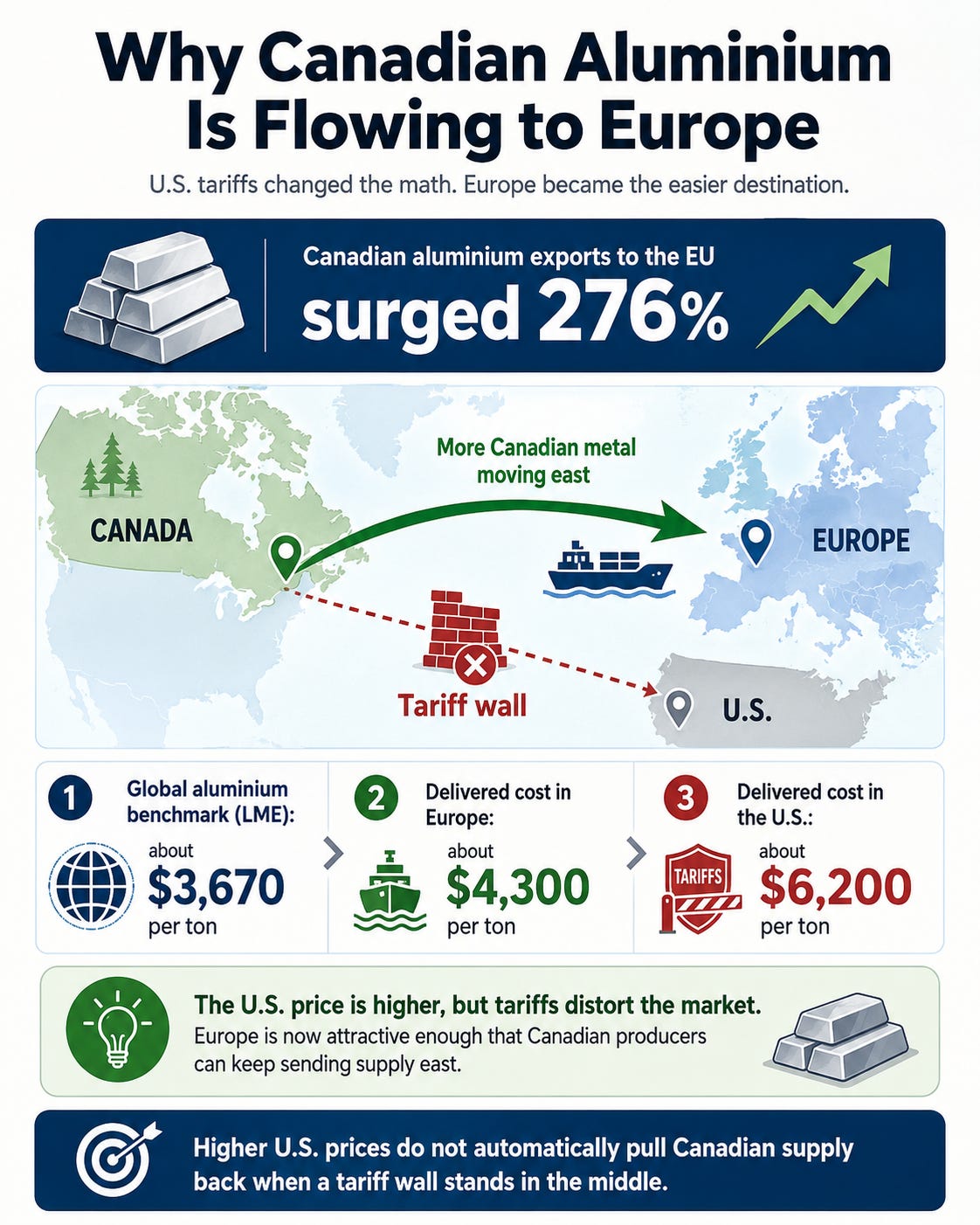
In plain English: Trump’s tariffs made the U.S. market expensive, but also less reliable. Europe is now paying enough, and looking strategically important enough, that Canada does not have to rush back just because American buyers are suffering.
Whatever genius plan the MAGA oligarch community cooked up in the United States, it is not working. Just look at U.S. aluminium production.
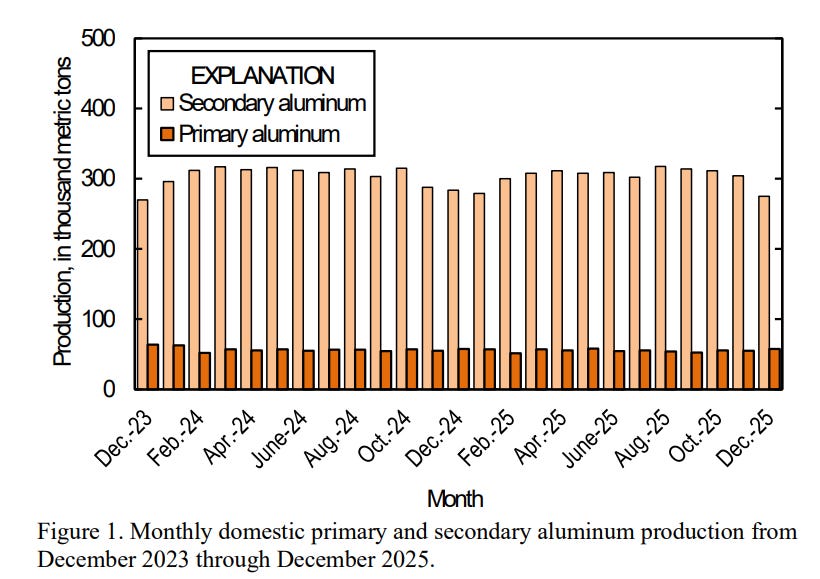
This is the part that gives the game away. If tariffs were actually rebuilding American industry, production should be rising. At minimum, it should be stabilizing. The price is higher. The global market is tight. Buyers are paying through the nose.
And yet U.S. production is not even flat. It is declining.
So what exactly did the tariff achieve?
It made aluminium more expensive for American consumers. It pushed Canadian supply toward Europe. And it still did not revive U.S. production.
That should not surprise anyone. No country can seriously expand aluminium and steel production without first addressing the cost of electricity. These are power-hungry industries. Cheap and reliable energy is not a side issue. It is the foundation.
Trump raised the wall around the market, but he did not fix the economics inside the wall. He did not solve the power-cost problem. He did not rebuild the industrial base. He simply made the input more expensive and waited for production to magically return.
Now the results have come calling.
That does not mean the story is over. There is a reasonable chance the U.S. price keeps rising until it becomes attractive enough for Canadian producers to shift supply back. Or Trump may eventually remove the tariffs and let the aluminium flow again. And then, one fine day, Canada will be right back where it started — trapped inside the same American circus.
Ottawa should not let that happen.
At the very least, Canada needs to secure a permanent place inside Europe’s aluminium supply chain. An export ban would be the wrong way to do it. The smarter path is for Canada, the EU and major European manufacturers to structure multi-year aluminium offtake agreements with Canadian producers.
Those contracts can guarantee volume, floor pricing, financing and take-or-pay commitments. Once Canadian producers have locked in European buyers for five to ten years, they will no longer be forced to react every week to the U.S. Midwest premium.
Canada has plenty of other tools as well. Leave the U.S. channel open. But assist every other channel aggressively. Use export finance. Use logistics support. Use government-backed credit. Encourage producers to sign long-term delivery agreements with European buyers.
Trump’s tariffs gave Canada an opening. Ottawa should turn that opening into a permanent rerouting of supply.
Make Trump’s tariff wall a gift Canada never gives back.
And Ottawa should stop treating loans as the only way to help Canadian manufacturers. In fact, it may be better if loans are not the main tool at all. Loans can keep companies alive, but they do not automatically rearrange supply chains.
What Canada needs now is harder. It needs long-term contracts, guaranteed European demand, export corridors, industrial coordination, and government support that helps manufacturers build permanent non-U.S. customer relationships.
That will put more pressure on Ottawa. It will put more pressure on Canadian producers too. But in the end, that pressure is the point. It forces the system to adapt. It helps Canada move from emergency diversification to structural diversification.
Concis Canada will keep fighting for the democratic alliance. Your support — whether through a free or paid subscription — helps power this desk and keeps the work moving.
Thank you.
So very interesting! I never see this sort of analysis anywhere else. The geniuses in Washington have done it again! Driven a true partner into the arms of a different lover!
Thanks for this analysis, I read both of your posts every morning, and learn a great deal every day. This is information I don’t see anywhere else.